
Your needs, this model
Does it fit your priorities?
How is the Studio Plus different from the Studio 5508?
Keiser describes both with the Studio Display and four-way seat adjustment. The 5509 has four-way handlebar adjustment including fore/aft travel; the 5508 has only two-way vertical adjustment. The 5509 also lists a 49 in height and 92 lb mass, versus 44 in and 87 lb for the 5508.
Explore this need in the finder →Does 72 gears mean 72 standardized resistance levels?
Keiser calls the Studio Display scale 72 gears while describing the underlying magnetic resistance as infinitely incrementally adjustable. That count helps describe the screen's scale, but it does not make effort comparable across brands or workouts.
Explore this need in the finder →What room dimensions should I plan for the 5509?
Keiser lists a 51 x 26 x 49 in body and 92 lb assembled weight. Measure the delivery route, floor, mounting area and added movement clearance separately; the body dimensions do not include the rider's space or assembly envelope.
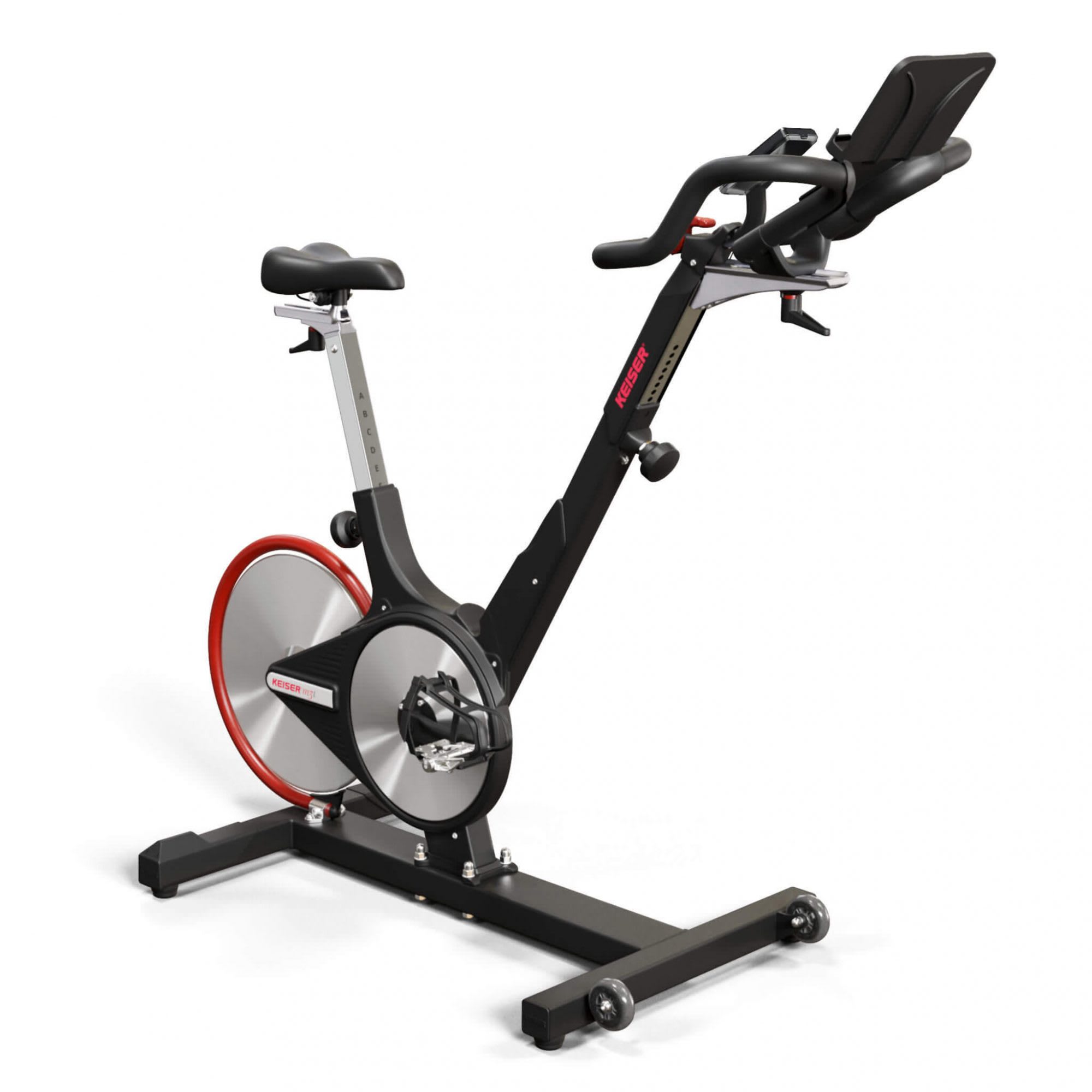
Explore this need in the finder →Keiser's M3i Studio Plus is Model 5509, and the current US shop record identifies SKU 005509BC. Its defining combination is the Studio Display and four-way handlebar adjustment. The less expensive-sounding “Studio” name is not enough to distinguish it from Model 5508: both share the self-powered 72-gear display and four-way seat adjustment, but the Plus also moves its handlebars fore/aft. That adjustment can matter for a rider who needs to change reach, while the larger frame and weight create separate setup questions.
A higher adjustment range, not a fit guarantee
Keiser lists the Plus for riders from 4 ft 10 in to 7 ft, with a maximum user weight of 350 pounds. The manual for Model 005509BC gives the corresponding 58–84-inch height range and the same weight limit. The four-way handlebars and four-way seat let the rider adjust height and fore/aft position at both contact points. Those are useful differences from the two-way vertical handlebar on the Studio 5508, but the manufacturer does not publish all travel measurements or a custom fit chart. The stated rider range should be treated as screening guidance rather than a promise that the saddle, pedal stroke and bar reach will suit everyone within it.
The Plus measures 51 inches deep, 26 inches wide and 49 inches high by Keiser's listing, and weighs 92 pounds. That is seven pounds heavier and five inches taller than the Studio 5508, which Keiser lists at 87 pounds and 44 inches high. The nominal width and depth are the same. Use those numbers to plan the floor area, then add room to mount, dismount, move around, unpack and assemble. The mass also matters for stairs, delivery handling and floor access; the small footprint alone does not make setup effortless.
Studio Display: many metrics, a particular interpretation
Keiser's Studio Display includes color-coded Ride by Color training, speed, FTP and heart-rate zones, four display modes and 72 displayed gears. The magnetic resistance system is described as infinitely incrementally adjustable. The gear count is useful when repeating a personal setting on the same system, but it is not a standardized effort unit and does not equate the Plus's 72 values with a competitor's 100 magnetic levels. If you have a prescribed watt target, the display can show power, but you still need to confirm how your class or app reads that figure.
Keiser says the Studio Display connects through Bluetooth and ANT+ and uses a pedal-powered generator with a supercapacitor, so it does not use the M Connect display's two AA batteries. This is a different display and power arrangement from the M3i and Lite. Do not infer that a specific named app, heart-rate device or feature works just because the product page says Bluetooth or FTMS. Check the current Keiser compatibility list and the app's own device requirements for the exact configuration before treating connectivity as a deciding feature.
Fixed-gear pedals and assembly deserve attention
Keiser's M Series pedal can take standard workout shoes held in toe-cage straps or SPD-cleated cycling shoes on the opposing side. It is not the same as assuming any road-cleat pattern is compatible. Verify the actual pedal supplied by the seller, and follow the manual's directions for securing the foot, stopping and emergency braking. The machine needs assembly. Keiser's product page lists a package with the display and accessories, and its current copy describes access to The Ride, but offers and included items are not permanent facts. Confirm exactly what the purchase includes—especially tray, floor mat, tool kit, seat cover, pedals and any software entitlement—before comparing packages.
When to choose Plus over other M3i models
Keep the 5509 on the list when fore/aft handlebar adjustment and the Studio Display matter together. Choose a different M3i configuration to investigate if the 49-inch height or 92-pound weight complicates the room or delivery plan. The 5508 has the same type of Studio display but vertical-only handlebars and a smaller listed frame; the 5507 standard M3i has four-way cockpit adjustment but the 24-gear M Connect display; Lite 5503 is also vertical-only, and its rider-height claims conflict. These are source-supported comparisons, not a ranking or a prediction of which bike will feel better.
Before ordering, match the offer to Model 5509/SKU 005509BC, download the manual for that exact configuration, check the room and access path, and settle any rider-fit questions. Verify the display, pedal and accessory package, device pairing, support contact, return terms and written warranty with the seller. No stock, price or personal test result is asserted here. This review is original source-based analysis; it does not claim that the author rode, assembled or measured the bike. If a recumbent seat, exact app guarantee, or a different adjustment scheme is essential, continue comparing rather than treating this model's broad feature list as a substitute for that requirement.
Key specifications
Key details at a glance
| US retail SKU | 005509BC |
|---|---|
| Riding format | Indoor cycling / studio-style bike |
| Resistance mechanism | Magnetic, infinitely incrementally adjustable |
| Resistance levels | 72 |
| Maximum user weight | 350 lb |
| Console | Studio Display with Ride by Color training modes, four intensity modes and a 72-gear scale. |
| Listed length | 51 in |
| Listed width | 26 in |
| Listed height | 49 in |
| Assembled weight | 92 lb |
| Named connected apps | |
| Bluetooth app protocol | Studio display supports ant+ and bluetooth cscs/cps/ftms data connections; a named third-party app/device combination is not guaranteed by protocol support alone. |
| Pedals | M series pedal supports standard workout shoes secured in toe-cage straps or cycling shoes with spd cleats; confirm the exact package. |
Use the exact model’s instructions for operating limits, supplied equipment and version differences.
Sources for this review
Sources for this assessment
- Keiser M Series current model comparison
- Keiser M3i Studio Plus product specifications, Model 5509
- Keiser US M3i Studio Plus product and package page, SKU 005509BC
- Keiser M3i Studio Plus Installation and Operation Manual; includes model 005509BC
- Keiser M Series model comparison; Model 5509 display and handlebar differences
- Keiser official Model 5509 product-page image

Put the details together
Use the finder to compare format, app support, resistance steps and the limits that matter in your room.