
Your needs, this model
Does it fit your priorities?
Is the M3i TBT an air bike because it has moving handles?
No. Keiser's Model 5512 page describes magnetic resistance, and the manual gives 24 displayed gear values; moving arms do not make it a fan-resistance bike. This assessment maps its seated pedaling posture to the finder’s upright option, not to the air-resistance choice.
Explore this need in the finder →Can I isolate the upper body or keep the arms still?
Keiser describes combined arm-and-leg work, pedal-only focus with hands resting on the arms, and upper-body work with feet on the stationary pegs. The FAQ states that the arms cannot be locked, so it is a poor fit if a stationary handlebar is essential.
Explore this need in the finder →Which user-weight limit should I rely on?
The exact 2025 manual for models 005512BBC/XXC and the current shop FAQ say 350 lb, but the current model-page FAQ says 300 lb. This fact record uses 350 lb from the manual and shop for matching; confirm the applicable value with Keiser and the exact unit label if capacity is a hard safety or fit requirement.
Explore this need in the finder →Is a 29-inch-wide room enough?
The listed body width is 29 inches, but the manual also calls for 24 inches of free area on all sides. Allow more room for the moving arms, entry, movement and assembly; a finder width match compares the body dimension only.
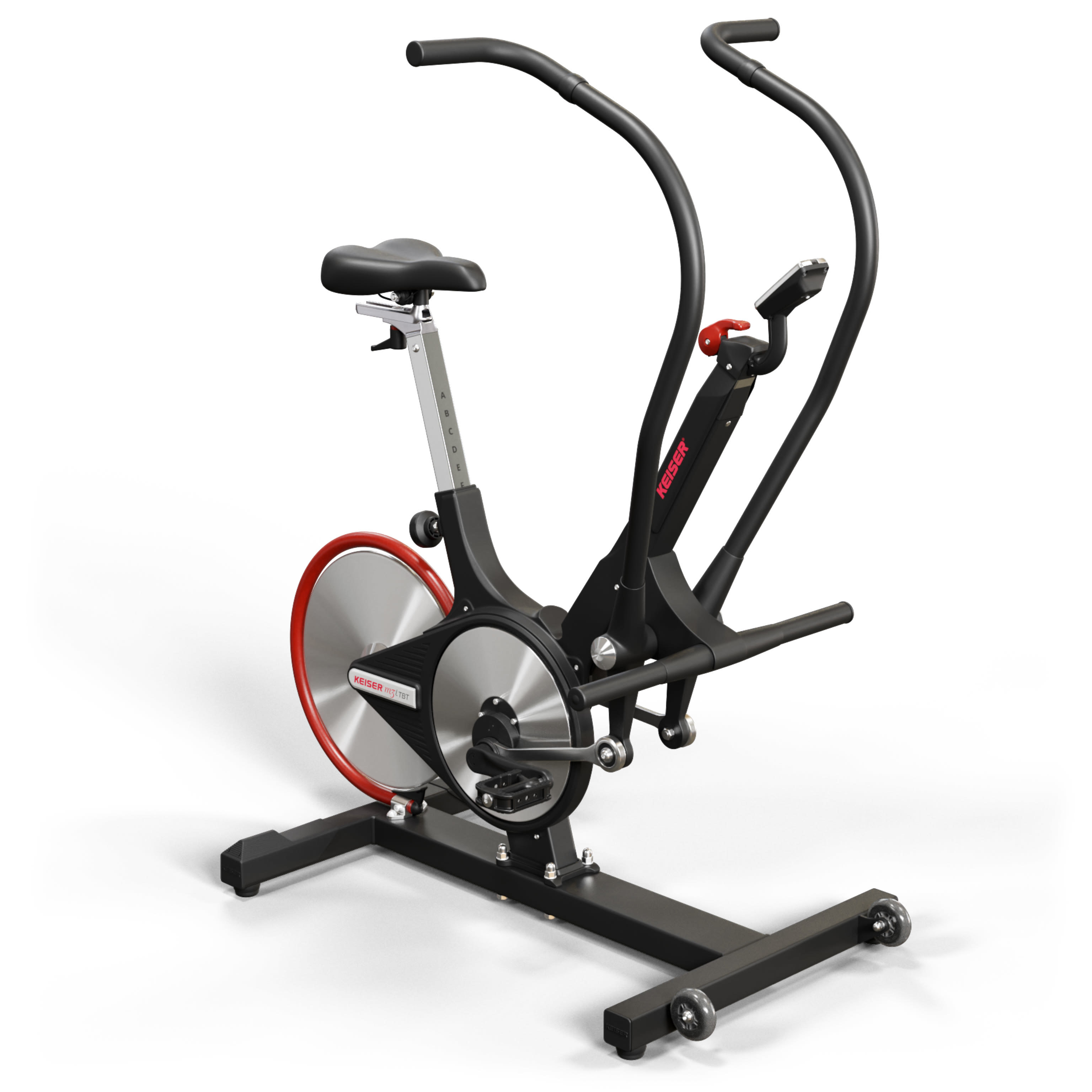
Explore this need in the finder →Keiser's current cardio page identifies the M3i Total Body Trainer as Model 5512. Its US home-shop listing exposes SKU 005512BBC, and the 2025 assembly-and-operation manual lists that exact black-frame configuration. This is a distinct, bike-like machine rather than an M3i indoor-cycle package: it combines a saddle and pedals with large moving exercise arms and stationary foot pegs. It is included in this exercise-bike library because it supports seated pedaling, but the finding is not a suggestion that it behaves like a conventional upright or an air bike.
The moving arms change the workout, not the resistance type
The 5512 uses magnetic resistance. Keiser describes a full-body mode that combines arm movement with pedaling, a lower-body-focused mode in which the rider rests hands on the arms and concentrates on pedaling, and an upper-body mode with feet on stationary pegs. The handles move with the exercise arms, and Keiser says those arms cannot be locked. If you want a fixed hand position, plan to use an ordinary stationary handlebar, or prefer a familiar upright bike without arm movement, that limitation is central rather than incidental.
The moving handles can look like the arms on an air bike, but the mechanisms are different. The 5512 uses magnetic resistance and its manual displays gears 1 through 24. The position marked gear 88 is an emergency brake, not another workout level. This 24-value display is a useful model-specific reference; it is not a standardized measure of effort and should not be used to rank load against a different brand's numbers. In the current questionnaire, the seated pedaling layout is mapped to the upright choice. The air-bike option is reserved for fan resistance with moving handles, so the two should not be conflated.
Fit and space need more than the body measurements
The exact manual lists a 58–82-inch user-height range, a 112-pound machine weight and a 49-inch length by 29-inch width by 54-inch height. Keiser calls the seat four-way adjustable, with height and horizontal depth adjustment. These specifications give a useful first screening point, but the published range is not an individual fit guarantee and the listing does not quantify every joint's adjustment travel. The width is also notably larger than most reviewed indoor cycles, before accounting for the moving arms.
The manual calls for at least 24 inches of free area on all sides. That clearance is separate from the 49-by-29-inch body dimensions and from space to approach the saddle, move the arms, get on and off, unpack the machine or assemble it. If your room is tight, measure the entire usable area, not just a gap that happens to be 29 inches wide. The transport wheels help reposition an assembled trainer on the floor; at 112 pounds, they do not solve stairs, narrow turns or a difficult delivery route.
Resolve the weight and configuration conflicts
The current manufacturer sources do not agree on one buying detail. The model-page FAQ currently says the maximum user weight is 300 pounds. The current US shop FAQ says 350 pounds, and the exact 2025 manual for model 005512BBC also lists 350 pounds. This assessment uses 350 pounds for its matcher because the model-numbered manual and current shop offer agree, but the visible disagreement remains important: confirm the rating for the unit and manual you will actually receive before relying on 350 as a hard capacity requirement.
There is a second package conflict. Keiser's model card calls the display “Standard,” while the current shop offer notes an M Connect display; the 2025 manual supports Bluetooth and ANT+ heart-rate-monitor reception and documents transmission to Keiser's M Series app and Group App. That evidence does not establish JRNY, Zwift or Explore the World support, and no app subscription or device is promised here. Ask which display and pedal set are included in the exact offer. The manual lists toe clips and straps, whereas the model-page FAQ also describes clipless/strapless pedals; the current actual package should be confirmed. Keiser also says a media tray is not available because the exercise arms move dynamically.
Read the manual before treating it as home equipment
The 2025 manual classifies the 5512 as a Class S (Studio, commercial-use) product intended for a controlled sports or fitness environment under trainer supervision. Keiser also currently sells it to home customers. A home listing does not make the manual's use label disappear. Ask Keiser how the class and supervision language applies to a planned home setup, and follow the exact manual's assembly, user-limit, pedal and maintenance instructions. The model page's references to rehabilitation or physical therapy are not evidence of a treatment result; personal clinical suitability requires qualified advice.
Who should compare the 5512
The 5512 belongs on a shortlist when a seated cycle should also offer supported upper-body work, the user wants the option to focus on pedaling or use the foot pegs, and there is room for a wide frame plus clearance. The manual and shop page support a 24-gear display and 350-pound maximum, with the weight conflict disclosed above. The main drawbacks are equally concrete: its arms keep moving, the media tray is unavailable, the package wording around display and pedals conflicts, and its manual carries a supervised studio-class label. If you want an ordinary upright without moving arms, an indoor cycle, or an air-resistance bike, compare those product types separately rather than assuming the TBT covers all three.
This assessment does not claim personal use, a riding test, a measurement session or a medical result. It compares Keiser's model page, current shop offer, model-specific manual and product sheet. Before choosing an offer, verify SKU and frame label, user-weight rating, display version, pedals, included accessories, delivery and assembly, return terms, warranty and the current safety notices for that exact unit.
Key specifications
Key details at a glance
| US retail SKU | 005512BBC |
|---|---|
| Riding format | Upright |
| Resistance mechanism | Magnetic, infinitely incrementally adjustable |
| Resistance levels | 24 |
| Maximum user weight | 350 lb |
| Console | The 2025 model manual describes a display with cadence, power, calories, heart rate, time, distance and 24 gears; it transmits data to Keiser M Series mobile/tablet apps. The current model page labels the display Standard, while the current shop bundle notes an M Connect display. |
| Listed length | 49 in |
| Listed width | 29 in |
| Listed height | 54 in |
| Assembled weight | 112 lb |
| Named connected apps | Keiser M Series app / Keiser M Series Group App |
| Pedals | The exact manual's parts and setup sections list pedals with toe clips and straps, plus stationary foot pegs for upper-body-only use. the current model 5512 faq also calls the supplied pedals clipless/strapless; confirm the actual pedal set on the exact offer. |
Use the exact model’s instructions for operating limits, supplied equipment and version differences.
Sources for this review
Sources for this assessment
- Keiser current M Series cardio listing for Model 5512
- Keiser M3i Total Body Trainer Model 5512 specifications and operating options
- Keiser current US M3i Total Body Trainer shop item; SKU 005512BBC
- Keiser 2025 M3i Total Body Trainer Assembly and Operation Manual; includes model 005512BBC
- Keiser M3i Total Body Trainer Model 5512 product sheet
- Keiser M Series support and manuals index
- Keiser official M3i TBT Model 5512 product-page image
- CPSC recall and product-safety index checked for Keiser M3i Total Body Trainer 5512

Put the details together
Use the finder to compare format, app support, resistance steps and the limits that matter in your room.