
Your needs, this model
Does it fit your priorities?
Does the current M3i connect to Zwift?
Keiser lists Zwift among compatible apps for the current M3i with its M Connect display. Check your specific device, app version and offer; that compatibility does not mean a device or any app membership is included.
Explore this need in the finder →What does 24 gears mean on the M3i?
Keiser describes a 24-gear M Connect display alongside infinitely incremental magnetic resistance. Treat 24 as its displayed gearing scale, not a universal effort rating or proof of 24 fixed mechanical notches.
Explore this need in the finder →Can I use ordinary shoes or SPD cycling shoes?
Keiser describes the M Series pedal as usable with standard workout shoes secured by the toe-cage straps or with SPD-cleated cycling shoes on the opposite side. Confirm the pedal on the exact offer and follow the manual's instructions for fitting and securing feet.
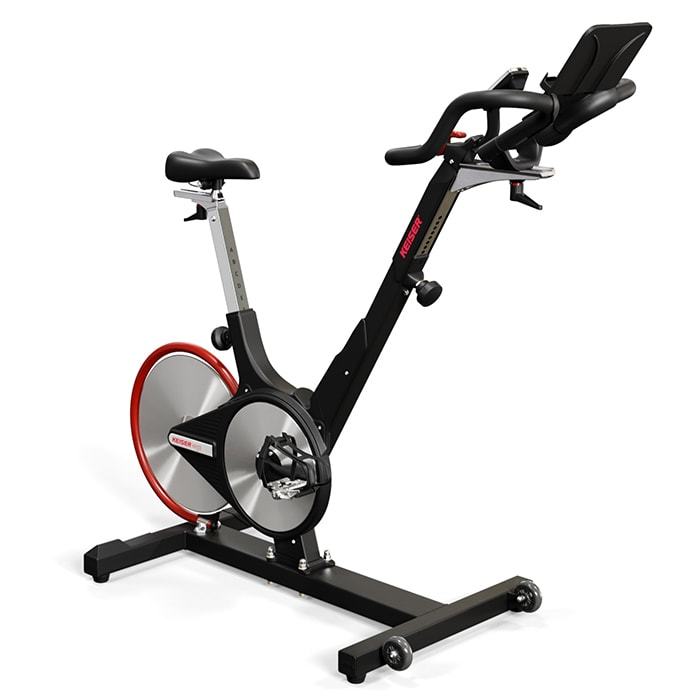
Explore this need in the finder →Keiser's M3i is a studio-style indoor cycle whose useful distinction is not simply that it has Bluetooth. The current US product page identifies Model 5507, the retail page exposes SKU 005507BBC, and the corresponding assembly-and-operation manual lists that model number. That gives this assessment a more specific base than a reseller title that says only “M3i.” It is a manually adjusted, magnetic-resistance bike with a 4-way seat and handlebar setup, a rear flywheel, and an M Connect display. The fit decision is therefore about cockpit adjustment, shoe interface, display workflow and space—not a promise of personal comfort.
Four-way adjustment is the practical divider
Keiser publishes a 4 ft 10 in to 7 ft rider range for the M3i and also uses the same endpoint range in its manual for Model 005507. The seat and handlebars each adjust both vertically and fore/aft. That breadth is relevant if several people share a bike or if you need to move the hand position rather than only raise it. It is still a manufacturer range, not a fit guarantee: the page does not give saddle travel in inches, crank length or a fit chart for inseam and torso proportions. If the cockpit position is essential, compare the actual range on a demonstrator or ask Keiser to confirm the relevant setup dimensions.
The model's listed body is 51 inches deep by 26 wide by 49 high, and Keiser lists 92 pounds. Those measurements help with an initial layout, not a complete installation plan. They do not include the rider's side-to-side movement, a comfortable mount and dismount path, floor protection or the space needed to unpack and assemble it. The transport wheels help move the bike after it is assembled, but do not make a 92-pound machine easy to carry upstairs. Check the access route and floor before choosing the room.
Resistance and display: useful data, not a universal scale
The M3i's magnetic system is described as infinitely incrementally adjustable, while the M Connect screen reports 24 gears. Keiser presents those gears as a way to track or repeat a setting. They should not be mistaken for 24 mechanical detents or a standardized effort unit comparable with another bike's numbered resistance. A “24 gear” label is a display scale; watts, cadence and rider effort answer different questions. If your exercise plan depends on a particular workload, confirm what the display and chosen app actually receive rather than comparing gear numbers across machines.
Keiser names Zwift among apps compatible with the M Connect version sold for this model. The screen sends ride data over Bluetooth, and Keiser describes sharing cadence, speed, power and heart rate with compatible apps. A phone or tablet is a separate device, and the listing does not promise that every app feature, operating system, sensor or software revision will work in every combination. The bike also supports Keiser's M Series app. Confirm the current app and subscription terms directly if those are part of your routine; “Bluetooth” by itself does not certify an integration.
Pedals, setup and practical limitations
The M Series pedal gives two common shoe routes: ordinary workout shoes can be secured with the toe-cage straps, while the opposite side accepts cycling shoes with SPD cleats. That is more flexible than a cleat-only pedal, but it does not mean every road-shoe system fits. Keiser's manual warns that this is a fixed-gear bike and that the rider must secure feet before pedaling; follow the manual rather than treating the bike like a freewheeling road bicycle. Confirm that the exact package includes the expected pedal and straps, especially for a used machine.
The current M3i package page lists a display and several accessories, but package terms can change and used units can be incomplete. Before purchase, verify SKU 005507BBC or the exact frame label, the M Connect display, the pedal interface, any tray or mat, the correct manual, return terms and written warranty. The manufacturer says basic assembly is required and provides a model-family manual that includes 005507; use the instructions for the exact machine and do not assume an older M3 or M3i computer has the same connections.
Who should compare it—and who should keep looking
The M3i is a plausible shortlist candidate when you want four-way cockpit movement, a 350-pound published user limit, a compact listed footprint and a named Zwift path. Its strongest contrast inside Keiser's line is the M3i Lite: the Lite keeps a similar M Connect display and 24-gear readout but lists only vertical handlebar movement and has conflicting published rider-height ranges. The Studio 5508 shifts to the self-powered 72-gear Studio Display but returns to vertical-only handlebars; the Studio Plus 5509 pairs that display with fore/aft adjustment. These distinctions matter more than the shared red-rimmed rear wheel or brand name.
This is not a claim of personal testing, a measurement session or a guarantee of quiet operation. It is a source-based comparison of the current product information and the model-numbered manual. Keep looking if you require a recumbent backrest, air resistance with moving handles, a certain unverified third-party app feature, or a clear rider-fit measurement that Keiser has not published. The published 350-pound limit, listed dimensions and app label are useful screening facts; they do not certify comfort, room clearance, seller condition or suitability for a particular person.
Key specifications
Key details at a glance
| US retail SKU | 005507BBC |
|---|---|
| Riding format | Indoor cycling / studio-style bike |
| Resistance mechanism | Magnetic, infinitely incrementally adjustable |
| Resistance levels | 24 |
| Maximum user weight | 350 lb |
| Console | M Connect display: RPM, watts, calories, time and distance; displays a 24-gear scale and connects by Bluetooth. |
| Listed length | 51 in |
| Listed width | 26 in |
| Listed height | 49 in |
| Assembled weight | 92 lb |
| Named connected apps | Zwift |
| Bluetooth app protocol | M connect display; bluetooth app connection; product page does not define universal device capability. |
| Pedals | M series pedal with toe-cage straps for standard athletic shoes on one side and spd cleat engagement on the other. |
Use the exact model’s instructions for operating limits, supplied equipment and version differences.
Sources for this review
Sources for this assessment
- Keiser M Series current model comparison
- Keiser M3i Indoor Bike product specification page, Model 5507
- Keiser US M3i product and package page; SKU 005507BBC
- Keiser M3i Assembly and Operation Manual; includes model 005507BBC
- Keiser cardio-display third-party app compatibility table; cross-check for M Connect
- Keiser official M3i product-page image

Put the details together
Use the finder to compare format, app support, resistance steps and the limits that matter in your room.