
Your needs, this model
Does it fit your priorities?
Can the 190's handlebars be adjusted for reach and height?
Schwinn specifies four-way adjustable handlebars, plus an adjustable foam seat. The product page does not provide an individual rider-fit chart, so use the exact bike's adjustment range and your own riding position to check fit.
Explore this need in the finder →Which app connections does Schwinn list for the 190?
The current page names JRNY and Zwift and describes full FTMS Bluetooth connectivity. It separately states that connected apps require a digital subscription; full FTMS is not a promise that every app or device will work.
Explore this need in the finder →How should I check the 190's room fit?
The manufacturer lists a 47-inch length and 32.3-inch width. Those are the bike's listed dimensions only; measure a route for assembly and leave space to mount, dismount and move safely around it.
Explore this need in the finder →Why the 190 is a distinct upright option
The Schwinn 190 Upright Bike is a source-documented step above the 130 in several concrete ways: 25 rather than 16 magnetic resistance levels, a 7-inch LCD rather than an unspecified-size LCD console, full rather than partial FTMS Bluetooth, built-in USB charging, and four-way adjustable handlebars. The current US listing identifies SKU HCB0267-OS and gives a 330-pound maximum user weight. Those are meaningful comparison points, not proof that this machine is automatically more comfortable or a better value for every rider.
This review is based on Schwinn's product information and the linked 190 owner/assembly manual index. It is not based on riding or testing the bike. I cannot verify resistance feel, noise, long-term reliability, assembly time or the experience of using an app with a particular phone. Treat the published figures as a way to make a tighter shortlist, then check the exact package and rider fit.
Fit, position and cockpit adjustment
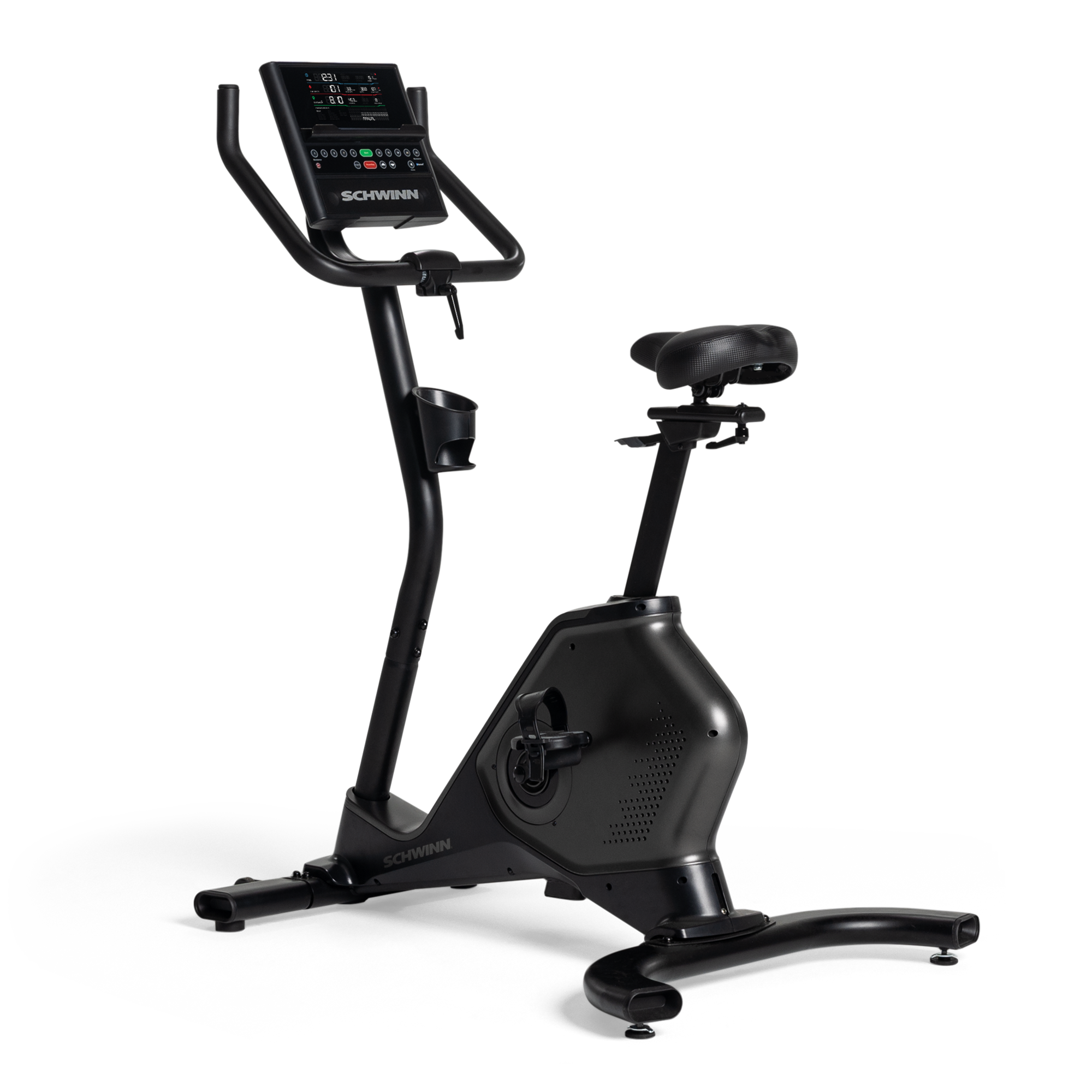
The 190 has an upright frame and an adjustable foam comfort seat. Schwinn describes the handlebars as four-way adjustable, which gives a rider more ways to set handlebar height and fore-aft position than a fixed bar would. The current page does not give a rider-height range or a complete adjustment measurement, so those features do not settle fit on their own. If two people share the bike, check that the seat and bar positions can be returned reliably and that each person can reach the pedals with a controlled leg extension.
Its listed assembled dimensions are 47 inches long, 32.3 inches wide and 56.8 inches high; listed weight is 80.7 pounds. In a tight room, check the width as well as the length: handlebar and pedal clearance may matter as much as the central frame. The product's bare dimensions do not include a rider's movement area, a route for carrying the bike into the room or temporary working space needed during assembly. Schwinn's page ties minimum ceiling height to the rider's height, another reason to measure the user-space combination rather than just the machine.
Weighted strapped pedals are listed, along with a water-bottle holder, media shelf, transport wheels and a Bluetooth heart-rate feature. Schwinn says the heart-rate strap is not included. If your footwear or sensor is non-negotiable, confirm the interface before ordering; a strap system is not interchangeable with every cleat or wearable simply because Bluetooth appears in the specification list.
Resistance and console
The 190 uses 25 magnetic resistance levels and includes 13 workout programs. It is fair to compare the documented number of steps with the 130's 16, but it would be misleading to convert that difference into a claim about smoothness, maximum workload or precision. Schwinn does not publish a standardized cross-model resistance scale or watt output in the page reviewed here. A larger count is useful only if the feel and program behavior work for the rider's intended sessions.
The 7-inch LCD is a clearly stated screen size, not an assurance that it behaves like a tablet or touchscreen. On-bike workout programs remain relevant if you want a self-contained session. The media shelf provides a place for another device, and the built-in USB charging port can address a small but practical concern for longer app-guided rides. Check which workout values remain visible while using your preferred setup; the product page does not answer every console-layout question.
Connected apps and what “full FTMS” means here
Schwinn names JRNY and Zwift and describes the bike's Bluetooth connectivity as full FTMS, connecting to a wider variety of apps and Bluetooth devices than the 130's partial-FTMS description. That is a more flexible compatibility claim, but it is not a promise that every app, sensor, operating-system version or feature works. If an app is the reason to choose the 190, compare Schwinn's supported-app information with the app's current device requirements before purchase.
The manufacturer says a separate digital subscription is required for connected apps. The bike also has built-in programs, so an app subscription is not the same thing as whether the bike can start a workout. Budget for the app only if its coaching, classes or data features are part of your plan, and verify current membership terms with the service provider. Promotions or trial periods should not be treated as permanent ownership costs.
Power, assembly and ownership checks
The product page specifies a standard 110–120 V household circuit and says the power cord is included. The linked manual index offers a 190 owner's and assembly manual; the downloaded manual is titled for the 190 and includes assembly, console-operation, maintenance and troubleshooting sections. That is a useful model-specific starting point. Read the instructions for safe assembly, leveling, movement and care instead of borrowing instructions from another Schwinn bike.
The product page lists a 10-year frame warranty, two years for mechanical parts, one year for electronics and 90 days of labor. These are manufacturer-stated terms, not an assurance that every seller, refurbished unit or region receives the same coverage. Confirm the warranty for the specific serial-numbered unit and purchase channel. Also confirm what is in the carton: a heart-rate strap is explicitly not included, and apps require separate subscriptions.
Bottom line
Shortlist the 190 when an upright riding position is what you want and you value its documented 25 resistance steps, 7-inch console, four-way handlebar adjustment, USB charging or broader full-FTMS claim. Compare it with the 130 if you do not need those differences; compare it with the 290 only if a recumbent posture is also acceptable. The 290 is longer and heavier but adds a padded ventilated backrest and stationary entry-and-exit handlebars.
Before choosing, measure the entire usable area, confirm the rider can reach the pedals and bars, and decide whether the named apps and their subscriptions are relevant. The 190's specification sheet is unusually helpful for a preliminary comparison, but neither a product page nor this research-based assessment can certify personal fit or simulate the ride.
Key specifications
Key details at a glance
| US retail SKU | HCB0267-OS |
|---|---|
| Riding format | Upright |
| Resistance mechanism | Magnetic |
| Resistance levels | 25 |
| Maximum user weight | 330 lb |
| Console | 7-inch LCD console |
| Display size | 7 in |
| Listed length | 47 in |
| Listed width | 32.3 in |
| Listed height | 56.8 in |
| Assembled weight | 80.7 lb |
| Named connected apps | JRNY / Zwift |
| Bluetooth app protocol | Full FTMS; connects to a wider variety of apps and Bluetooth devices |
| Built-in USB charging port | Yes |
| Seat | Adjustable foam comfort seat |
| Pedals | Weighted pedals with straps |
Use the exact model’s instructions for operating limits, supplied equipment and version differences.
Sources for this review
Sources for this assessment
Put the details together
Use the finder to compare format, app support, resistance steps and the limits that matter in your room.