
Your needs, this model
Does it fit your priorities?
Which apps does the current 230 support?
Schwinn names Explore the World and Zwift and describes partial FTMS. A separate phone or tablet runs the app, and a subscription is required. Check the app's current device list before relying on a specific pairing.
Explore this need in the finder →How do the 230's seat and access features work?
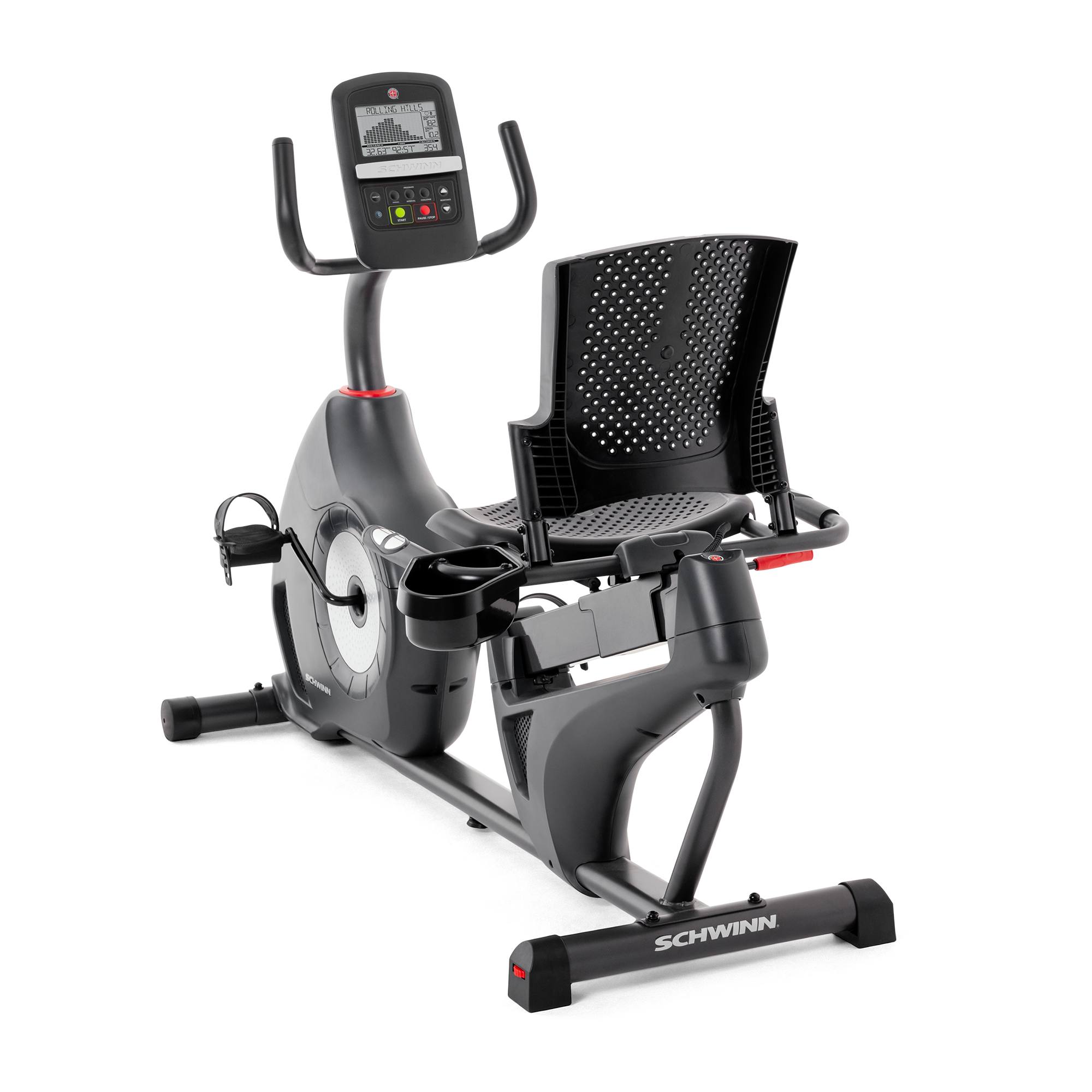
Schwinn lists a contoured adjustable seat with a vented back and lumbar support, a seat-rail slider with an adjustment lever, and stationary handlebars intended to ease entry and exit. The listing does not provide step-through height or seat-travel measurements.
Explore this need in the finder →Will the 230 fit a 64-inch room opening?
The body is listed as 64 inches long, 27.7 inches wide and 44 inches high. That excludes setup and access clearance, and does not establish doorway fit; measure the package route and compare actual openings before ordering.
Explore this need in the finder →A verified current 230, with a clearer paper trail
The current U.S. Schwinn store identifies a 230 Recumbent Bike under SKU HRB0119-OS. That resolves a previously broken product-page bridge: the current model page now loads with its specifications, while its linked parts/manual record identifies a Schwinn 230 Recumbent Bike. The manual cover is labeled “230 / 510R,” so the document is a shared-model manual rather than a claim that this retail bike is a 510R. It is also distinct from the 230i and 270i international manual records. This review concerns the current listed U.S. 230, not every machine that has carried a 230 name over time.
The 230 is a recumbent design with a broad contoured seat, vented back and lumbar support. Schwinn describes a seat-rail slider with an adjustment lever and stationary handlebars intended to ease entry and exit. Those are potentially useful design choices for someone who wants a supported seated posture, but they do not establish a safe transfer, comfortable fit or therapeutic benefit for any individual. The product page gives no rider-height range, step-through height or measured seat-travel range. If those details decide whether the bike is suitable, inspect the exact machine or obtain a fit check before purchase.
Console-led workouts, with an optional phone route
For a standalone ride, Schwinn lists 16 magnetic resistance levels, 13 onboard workout programs and an LCD console. A distinct connected option names Explore the World and Zwift; a separate phone or tablet supplies those apps, and Schwinn says connected apps require a subscription. The manufacturer comparison identifies Bluetooth connectivity as partial FTMS and says the 230 has no built-in USB charging port. App support is specific, not universal: verify the current app version, device operating system, pairing behavior and any subscription before treating a connection as essential. The onboard programs remain a separate route if you would rather use the bike’s own console.
Schwinn also lists Bluetooth-enabled heart-rate tracking and contact grips, but says the heart-rate strap is not included. Do not assume the console is a full-size media display: the listed screen is a streamlined LCD, while a separate media shelf holds a personal device. The page does not specify a resistance watt range or a standardized comparison between these 16 steps and another maker’s levels.
Published size, access and setup checks
The manufacturer lists a 64-inch length, 27.7-inch width and 44-inch height, with an assembled weight of 81.6 pounds and a maximum user weight of 300 pounds. These are catalog specifications, not measurements made for this assessment. The body length alone is not the space allowance: leave room to approach the seat, adjust it, pedal, get on and off, assemble the bike and move around it. Measure doorways, landings and turns along the delivery route too. The published weight is manageable compared with some larger recumbents, but still worth planning for if there are stairs or a narrow route.
The 230 uses a cord on a standard 110–120 V household circuit. Schwinn lists a ten-year frame warranty, two years for mechanical parts, one year for electronics and 90 days of labor; the support page says warranty coverage is for home use. Confirm the exact written terms and the seller’s included pieces, particularly if the unit is not new or not sold directly by Schwinn. The page’s linked shared 230 / 510R owner-and-assembly manual is useful for setup, but check that the serial/model label on the machine corresponds to the instructions supplied with the specific unit.
Where it sits beside the 290
Both Schwinn models are recumbent and support a named app, but their documented trade-offs differ. The 230 has 16 resistance levels, 13 programs, partial FTMS, no onboard USB port, a 300-pound published limit and an 81.6-pound assembled weight. The current 290 lists 25 levels, the same number of programs, full FTMS, USB charging, a 330-pound limit and 107.6 pounds assembled. The 230’s listed body is shorter and lighter; the 290 has a higher published capacity and broader protocol claim. Neither comparison establishes that one will fit a particular body or room better—seat geometry and movement clearance still need checking.
The 230 is worth comparing when a recumbent layout, adjustable backrest, onboard workouts and Explore the World or Zwift support line up with the shopping brief, and when a 300-pound published maximum and the 64-inch listed body meet the non-negotiable screens. It is a poor shortcut for anyone who needs JRNY support, a 330-pound minimum or a confirmed seat-transfer measurement: those conditions are not documented for this model. This is a source-based product assessment, not a hands-on fit or performance test.
Key specifications
Key details at a glance
| US retail SKU | HRB0119-OS |
|---|---|
| Riding format | Recumbent |
| Resistance mechanism | Magnetic |
| Resistance levels | 16 |
| Maximum user weight | 300 lb |
| Console | Streamlined LCD console with 13 workout programs |
| Listed length | 64 in |
| Listed width | 27.7 in |
| Listed height | 44 in |
| Assembled weight | 81.6 lb |
| Named connected apps | Explore the World / Zwift |
| Bluetooth app protocol | Partial FTMS; connects to specific apps |
| Built-in USB charging port | No |
| Seat | Adjustable contoured seat with large vented back and lumbar support |
Use the exact model’s instructions for operating limits, supplied equipment and version differences.
Sources for this review
Sources for this assessment
Put the details together
Use the finder to compare format, app support, resistance steps and the limits that matter in your room.