
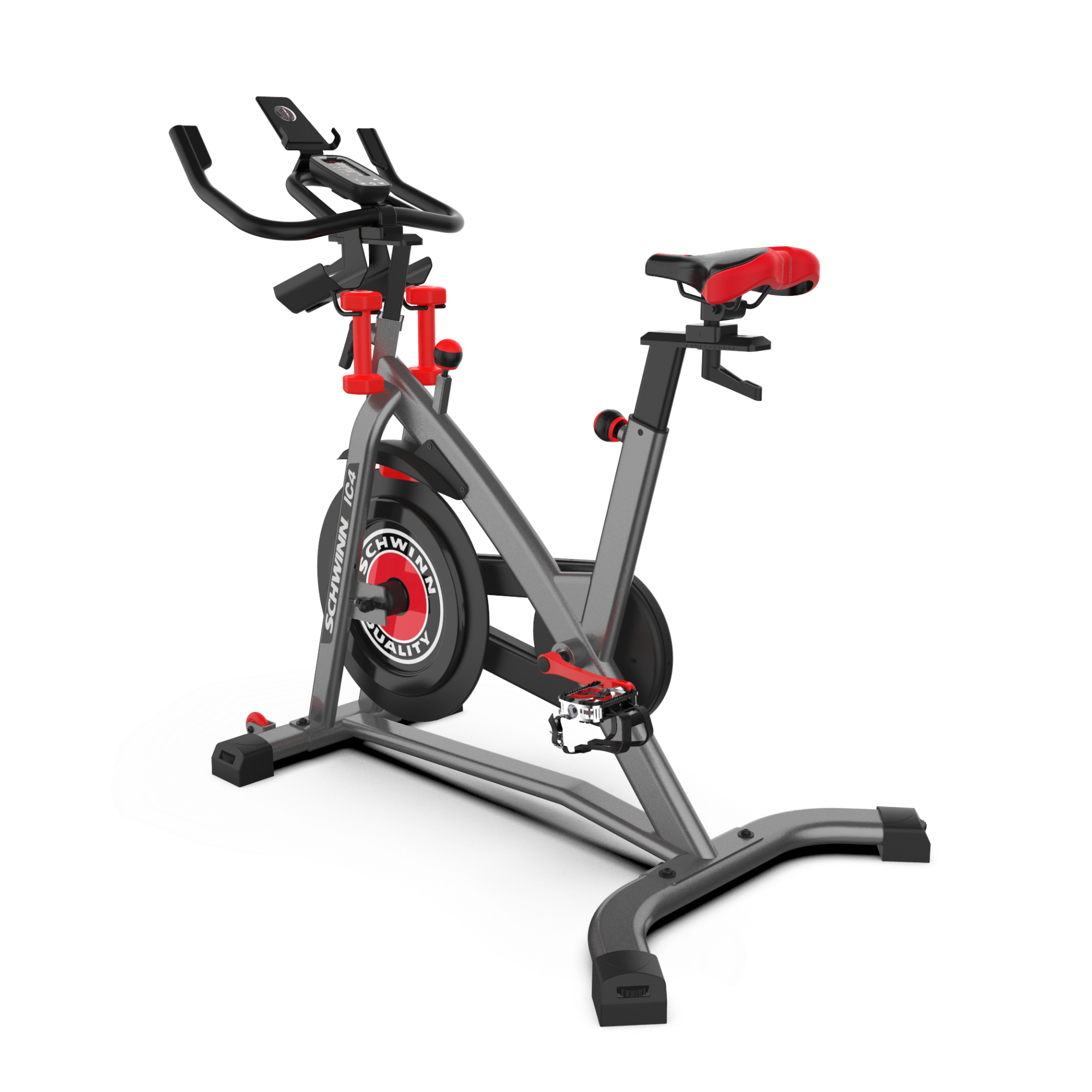
Your needs, this model
Does it fit your priorities?
Which training apps does Schwinn name for the IC4?
Schwinn lists JRNY, Peloton, Explore the World, Apple Health, Google Fit, Zwift and Kinomap. A separate phone or tablet supplies the app, connected use requires a subscription, and the stated protocol is partial FTMS rather than universal compatibility.
Explore this need in the finder →What is supplied with the IC4 for training and riding?
The product page lists a Bluetooth heart-rate armband, two 3 lb dumbbells, dual-sided SPD/toe-cage pedals and a device holder. Confirm package contents on the exact seller offer, especially for used units; the tablet itself is not included.
Explore this need in the finder →Is the IC4's recommended rider-height range clear?
Not fully. Schwinn's technical table says 5 ft 1 in-6 ft 4 in / 29-39 in inseam, while a product-page FAQ says 4 ft 6 in-6 ft 6 in / 30-39 in. Ask Schwinn to clarify and verify reach on the exact bike rather than treating either range as a fit guarantee.
Explore this need in the finder →The connected member of Schwinn’s IC pair
The current U.S. Schwinn store identifies the IC4 Indoor Cycling Bike as SKU HFC0065-OS. Compared with the IC3, its clearest functional difference is a connected-training package: Schwinn lists 100 magnetic resistance levels, partial FTMS Bluetooth, a backlit LCD metric console, a device holder, USB charging, a Bluetooth heart-rate armband and two 3-pound dumbbells. The product page names JRNY, Peloton, Explore the World, Apple Health, Google Fit, Zwift and Kinomap as app integrations. Those apps run on a phone or tablet supplied separately, not on a built-in streaming screen; Schwinn says connected apps require a separate digital subscription.
That breadth is a starting point, not a promise that every feature of every app will work with every device. Pairing support, data fields and subscription terms can change independently of the bike. If one named app is essential, check its current compatible-device list, operating-system requirements and the exact IC4 data it accepts. The product documentation calls Bluetooth “partial FTMS,” so avoid treating it as universal protocol support. For an unconnected ride, the console and resistance knob provide a separate route.
Adjustable cockpit, clear limits
The IC4 uses a race-style adjustable seat, handlebars that move up, down, forward and back, and dual-sided pedals with SPD clips on one side and toe cages on the other. That combination gives a rider options for footwear and reach adjustment, but it does not make the bike a custom fit. The product’s technical specifications recommend a height range of 5 feet 1 inch to 6 feet 4 inches or an inseam of 29–39 inches. A separate FAQ on the same manufacturer page gives a different range—4 feet 6 inches to 6 feet 6 inches, with a 30–39-inch inseam. Because these published limits conflict, do not use either as a definitive fit guarantee; ask Schwinn to clarify for the exact machine and test the cockpit if rider dimensions make the range decisive.
The page also lists a Bluetooth heart-rate armband and two small dumbbells with storage cradles. Verify the exact package contents and sensor compatibility with the seller rather than assuming an older or secondhand IC4 has all listed accessories. A tablet shown in product imagery is a demonstration device, not an included computer. The small LCD reports workout metrics; the connected device supplies app visuals.
Space, power and operating burden
Schwinn lists the assembled IC4 at 54.6 inches long, 30.7 inches wide and 51.8 inches tall, weighing 113.6 pounds. Its stated maximum user weight is 330 pounds. These are manufacturer specifications, not measurements taken for this review. The same product page’s ceiling guideline is rider height plus 20 inches. For a room plan, add pedal and handlebar clearance, a safe approach, the working envelope for riding, space to move it and the room needed to assemble it. The box must also travel through the home: Schwinn’s support article lists a single package of 40 x 9.5 x 33.5 inches and nine assembly steps. A relatively compact bike body can still be awkward to carry or maneuver.
The IC4 uses a supplied adapter on a standard 110–120 V circuit, unlike the battery-powered IC3 console. Schwinn lists a 10-year frame warranty, three years for mechanical parts and electronics, and one year of labor for home use. If buying outside Schwinn’s current U.S. retail channel, compare the serial/model plate, manual, included accessories, power adapter and written warranty before treating those current terms as applicable.
Choose it for the functions, not the feature count
Against the IC3, the IC4 raises the published maximum from 300 to 330 pounds, replaces the IC3’s unnumbered “infinitely variable” setting with 100 named magnetic levels, adds multiple app connections, USB charging and the bundled training accessories. It is also listed as 10 pounds heavier and 2 inches taller. The IC3 remains a reasonable alternative if app pairing is not wanted, a two-AA console is preferable and its published 300-pound ceiling is adequate. Neither product’s resistance numbering is a cross-brand performance scale, and the IC4’s higher maximum does not prove a personal comfort or fit result.
The IC4 is worth comparing when a studio-style cycle, the supported app list, a 330-pound published maximum and the magnetic resistance steps solve actual requirements. It is less compelling if a named app is not useful, if recurring subscriptions are unwelcome, or if the conflicting manufacturer height guidance cannot be resolved for the rider. The page-linked parts record is titled “IC4 (800ICi),” dated 2019, and the downloaded manual is labeled IC4 / 800IC; this supports the family identity but does not independently certify that every older part fits current SKU HFC0065-OS. Ask Schwinn for serial-specific service information when relevant. This is a documented-feature analysis, not a hands-on performance or comfort test.
Key specifications
Key details at a glance
| US retail SKU | HFC0065-OS |
|---|---|
| Riding format | Indoor cycling / studio-style bike |
| Resistance mechanism | Magnetic |
| Resistance levels | 100 |
| Maximum user weight | 330 lb |
| Console | Backlit LCD metric console; separate device holder |
| Listed length | 54.6 in |
| Listed width | 30.7 in |
| Listed height | 51.8 in |
| Assembled weight | 113.6 lb |
| Named connected apps | JRNY / Peloton / Explore the World / Apple Health / Google Fit / Zwift / Kinomap |
| Bluetooth app protocol | Partial FTMS; connects to specific apps |
| Built-in USB charging port | Yes |
| Seat | Adjustable race-style seat; range not published |
| Pedals | Dual-sided spd clips and toe cages for athletic shoes |
Use the exact model’s instructions for operating limits, supplied equipment and version differences.
Sources for this review
Sources for this assessment
Put the details together
Use the finder to compare format, app support, resistance steps and the limits that matter in your room.