
Your needs, this model
Does it fit your priorities?
Does the current LCB meet a strict 350-pound and 40-level upright screen?
SOLE's current LCB page identifies an upright configuration with 40 EMS settings and a 350 lb published maximum. Those are catalog screens, not a measure of rider comfort, safe personalized suitability or resistance intensity; confirm the exact SKU on the seller's package.
Explore this need in the finder →Does the LCB page establish a connection to Zwift, JRNY or Explore the World?
The current LCB page names the SOLE+ route and describes Bluetooth/FTMS/CSCS functions, but does not name Zwift, JRNY or Explore the World for this SKU. This library therefore does not count it for those named-app answers; ask SOLE about the exact app and device rather than treating Bluetooth as a compatibility promise.
Explore this need in the finder →What should be measured before placing an LCB in a room?
The current page lists a 56 x 29 x 60 inch body and a 112 lb unit weight. Measure the delivered path and separately plan access, assembly, moving pedals and safe use; the body dimensions are not an operating-clearance specification.
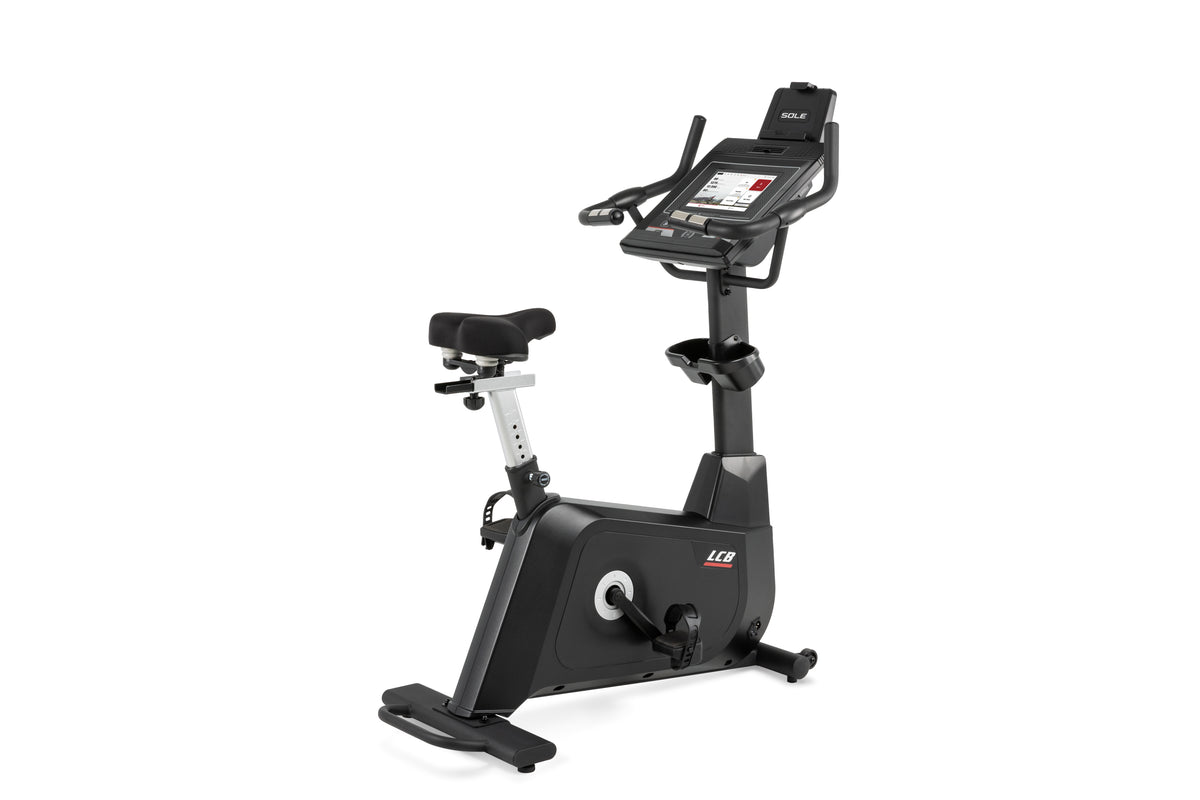
Explore this need in the finder →The current SOLE LCB listing is an upright bike with a fairly specific proposition: a large touchscreen and a higher counted resistance range than the simpler Schwinn upright models in this reviewed library. Its useful differences are concrete—40 listed EMS settings, a 10.1-inch display, a 350 lb published maximum and adjustable seat/handlebar setup—not a promise that the bike will feel right for every rider. This is a source-led assessment of the current US SKU LCB-2023, not a hands-on test.
What the LCB adds to an upright shortlist
SOLE currently describes the LCB as an upright light-commercial bike and exposes the SKU LCB-2023 in its product data. The page lists 40 EMS resistance settings and a 350 lb maximum user weight. The Schwinn 190 is a different, lighter-featured upright alternative with 25 magnetic levels and a 330 lb maximum; the Schwinn 130 has 16 listed magnetic levels and a 300 lb maximum. Those are manufacturer-published counts and limits, not comparable resistance-force measurements or a recommendation about any person's health or capacity.
The current LCB body is listed at 56 x 29 x 60 inches and the unit at 112 lb. Those numbers place it in a larger and heavier footprint class than compact upright options, even though the frame itself remains an upright configuration. Compare the actual room path and product dimensions rather than assuming that the word “upright” implies a small bike. The dimensions omit room to step on and off, move a pedal, reach the console and assemble the equipment.
The screen is a central part of the package
The product page specifies a 10.1-inch touchscreen, Wi-Fi and screen mirroring. It also lists built-in speakers, cooling fans, a tablet holder, wireless charging and Bluetooth functions. This feature set may suit someone who wants the console to be part of a session rather than relying only on basic workout windows. It is still worth checking the actual menu and screen workflow with the retailer: a display size says nothing about whether you like the controls, and screen mirroring is not the same as a bundled streaming or fitness subscription.
SOLE names its own SOLE+ app and describes it as free without a monthly subscription. The LCB page does not name Explore the World, JRNY or Zwift for this SKU, so generic Bluetooth or FTMS language should not be read as proof of those specific integrations. A rider who has a non-negotiable app should verify the exact console version, phone or tablet, and desired app activity with SOLE before ordering. A clear result from this finder is narrower: only an explicitly named compatible app counts toward the named-app choices.
Fit needs more than the frame label
The LCB uses an upright saddle position, not the supported backrest layout of SOLE's current LCR, R92 or R98 recumbents. Its product page describes a cushioned gel saddle that adjusts “up and over,” and lists a 29–42 inch inseam interval plus seat and handlebar adjustment. Treat that interval as a manufacturer screening detail, not a fit guarantee. Saddle shape, knee tracking, reach and ability to mount are individual questions that photographs and a product table cannot settle. If position is decisive, compare the frame geometry and arrange a proper fit check rather than inferring comfort from the upholstery description.
The manual situation deserves similar care. SOLE's current service index links a combined LCB/LCR 2023 Ver.E owner's manual with separate assembly sections for both bikes. The product page calls the current LCB “new and upgraded” and describes a 10.1-inch touchscreen. The shared manual is useful for understanding the bike-family setup, but it is not proof that every console or included accessory in a current LCB-2023 package matches every illustration in the older combined document. Ask the seller to identify the exact included manual and parts before treating a setup instruction as definitive.
What I would verify before delivery
First, confirm that the offer names LCB-2023 rather than a differently revised or reconditioned package. Next, compare the listed 56-inch length and 29-inch width with the doorway, turns and room layout, then add separate working and assembly space. The product page lists 110 V power; the exact adapter, grounding instructions and electrical requirements should come from the manual supplied for the specific package. SOLE also notes that wireless charging creates a magnetic field and directs people with implanted medical devices to consult their doctor. That is a manufacturer's caution, not an individualized medical assessment.
The current page labels the bike light-commercial, but the linked combined 2023 document and the current upgraded page do not resolve every detail of the shipped configuration or warranty application. A household buyer should confirm the warranty and parts package for the precise SKU; a business or shared facility should obtain direct confirmation that the exact application is covered. Do not assume that an appealing marketing label overrides the manual and warranty terms.
Bottom line
The LCB merits consideration when the goal is an upright frame, an integrated touchscreen, 40 counted EMS steps, a published 350 lb maximum and a seat setup with a stated inseam interval. Its footprint, 112 lb listed unit weight, unspecified support for the finder’s named third-party apps, and the current-manual/package bridge are meaningful tradeoffs. Compare it with the more compact Schwinn 130 or 190 if space and simpler consoles matter; compare SOLE's recumbent models only if a backrest position is actually preferred. No listed capacity or seat interval substitutes for an exact-model fit and manual check.
Key specifications
Key details at a glance
| US retail SKU | LCB-2023 |
|---|---|
| Riding format | Upright |
| Resistance mechanism | Ems (manufacturer label; mechanism not further specified) |
| Resistance levels | 40 |
| Maximum user weight | 350 lb |
| Console | 10.1-inch touchscreen with Wi-Fi and screen-mirroring features listed on the current product page |
| Display size | 10.1 in |
| Listed length | 56 in |
| Listed width | 29 in |
| Listed height | 60 in |
| Assembled weight | 112 lb |
| Named connected apps | SOLE+ |
| Bluetooth app protocol | Current product specifications list ble 3.0 audio, ble 5.0, and support for sole+ apps / ftms + cscs; this is not a claim of universal third-party app compatibility. |
| Seat | Cushioned gel saddle; the manufacturer says the seat adjusts up and over |
Use the exact model’s instructions for operating limits, supplied equipment and version differences.
Sources for this review
Sources for this assessment
Put the details together
Use the finder to compare format, app support, resistance steps and the limits that matter in your room.