
Your needs, this model
Does it fit your priorities?
Is LCR-2026 the same configuration as LCR-2023?
No. The all-products snapshot distinguishes the newer LCR-2026 product route and its embedded SKU from the older LCR-2023 listing. The 2026 page lists a 15.6-inch touchscreen and Zwift; the 2023 page lists a 10.1-inch console and does not name Zwift. Keep the product records separate and check the SKU on the offered unit.
Explore this need in the finder →Does the current LCR-2026 page name Zwift?
Yes. The exact LCR-2026 product page names Zwift with its 15.6-inch touchscreen configuration, so this family’s newer product record meets the finder’s Zwift app screen. That does not establish that an account, subscription or compatible personal device is included, and it is not evidence for LCR-2023.
Explore this need in the finder →Can this product meet a hard minimum resistance setting count?
Not from the current manufacturer evidence alone. The hero and full specification table say 40 EMS levels, while the page overview and its placeholder graphic say twenty. Because the source is internally inconsistent, the matcher keeps the field unknown rather than granting either threshold; ask SOLE to confirm the actual LCR-2026 console and count.
Explore this need in the finder →What does the current LCR-2026 body screen cover?
The product page lists a 56 x 29 x 61 inch body, a 350 lb published maximum and a 161 lb bike weight. Those figures are manufacturer specifications rather than independent measurements or rider-fit advice. They do not include the approach, seat travel, pedal sweep, assembly or delivery path, and they do not establish a personal safe capacity.
Explore this need in the finder →Is the LCR-2026 cleared for a shared or commercial room?
The page promotes light-commercial use, but the linked LCR_2026 Ver.A manual cover says residential use only and warns that other applications void warranty; a later warranty table separately describes limited light-commercial coverage. Ask SOLE and the seller to reconcile these statements in writing for the exact SKU, intended use and warranty before relying on a non-home installation.
Explore this need in the finder →A separate 2026 configuration, not a renamed LCR-2023
SOLE's current US all-products page and exact product route distinguish the LCR-2026 from the earlier LCR listing. The newer page's embedded variant identifies SKU LCR-2026; its prominent 15.6-inch tilting, swiveling color touchscreen and the listed Zwift and Peloton integrations differ materially from the LCR-2023's 10.1-inch screen and page that names SOLE+ alone. Keep those records separate when comparing a particular seller's unit. The page's captured purchase control was sold out when checked, so this assessment makes no promise about present stock, price, delivery or an offer. It is a source-led review of the identified configuration, not a ride test.
Recumbent layout and the body's listed dimensions
The product page identifies an adjustable recumbent seat with back support and 15 positions. That gives a concrete feature to ask about when comparing seat travel, but it does not establish a rider-height range, personal comfort or accessible transfer. A recumbent backrest is not proof of clinical or rehabilitation suitability. If the entry path or reach is important, inspect the seat's movement and the actual bike before committing rather than inferring fit from the frame label.
SOLE lists a 56 by 29 by 61 inch body, 161 lb unit weight and a 350 lb maximum user weight. These are attributed product-page values, not independent measurements or an individual suitability verdict. The body footprint is a starting point: the sliding seat, pedals, approach, transfer, hand access and assembly require room beyond those three dimensions. The listed mass also makes delivery-route checks important; confirm turns, stairs, floor access and which room-delivery or assembly service is actually in the offer. The current page shows a 110 V power source; consult the instructions and verify the grounded outlet and supplied components for the exact unit.
Do not assume the resistance count
The source is internally inconsistent about how many resistance steps the console offers. The product hero and full specification table say 40 EMS levels, while the overview paragraph says twenty, and the decorative placeholder graphic also prints twenty. Because those statements appear together on the manufacturer's own page, selecting the more favorable count would overstate the evidence. This review records no confirmed number for a hard resistance-minimum comparison. A buyer for whom counted steps matter should get written clarification for SKU LCR-2026 and the shipped console, then check that the offered unit's display and operating instructions use the same scale. Even a settled count would describe menu increments, not cross-brand workload or smoothness.
Named apps are a real difference, with separate account checks
Unlike the earlier LCR-2023 page, the LCR-2026 page names SOLE+, Zwift and Peloton in connection with the 15.6-inch display and preloaded streaming apps. Zwift is therefore a documented app route for this exact page configuration, which matters to the finder. Do not transfer that evidence backward to the LCR-2023. Nor does a supported app name mean the subscription is supplied: the product page says the SOLE+ upgrade has no monthly subscription, but account, membership, internet, device and service conditions may differ for Zwift, Peloton and any third-party content. Ask what is installed, what is accessible without another payment, whether the display or a personal device runs the session and how app updates are handled.
The page also lists Bluetooth, built-in audio, USB-C device charging, cooling fans, two bottle holders, a tilting/swiveling display, heart-rate program modes and wrist/chest-strap compatibility. It says the package has no tablet holder, so don't assume there is a separate place to mount a personal device if the console isn't the desired screen. The product page names eight standard, twelve user-defined and two heart-rate programs. These are manufacturer descriptions of a menu and interface, not evidence that every third-party app can change bike resistance or that a sensor is included. The exact supplied strap, app route, console revision and wireless functions should be checked with the seller.
Use and warranty language needs reconciliation
The current product page promotes light-commercial use. The SOLE support index links an LCR_2026 Ver.A manual whose cover says residential use only and warns that another application voids the warranty; the manual's later warranty table separately describes limited light-commercial coverage. These statements do not resolve cleanly into an unconditional approval for a studio, clinic, school or shared installation. Before relying on a non-home plan, ask SOLE and the seller to reconcile the cover, warranty table, exact SKU, intended hours/use, installation and written coverage. Retain the response and the manual shipped with the actual unit. A finder result can match app and physical dimensions but cannot answer this policy question.
Official model illustration and visual limits
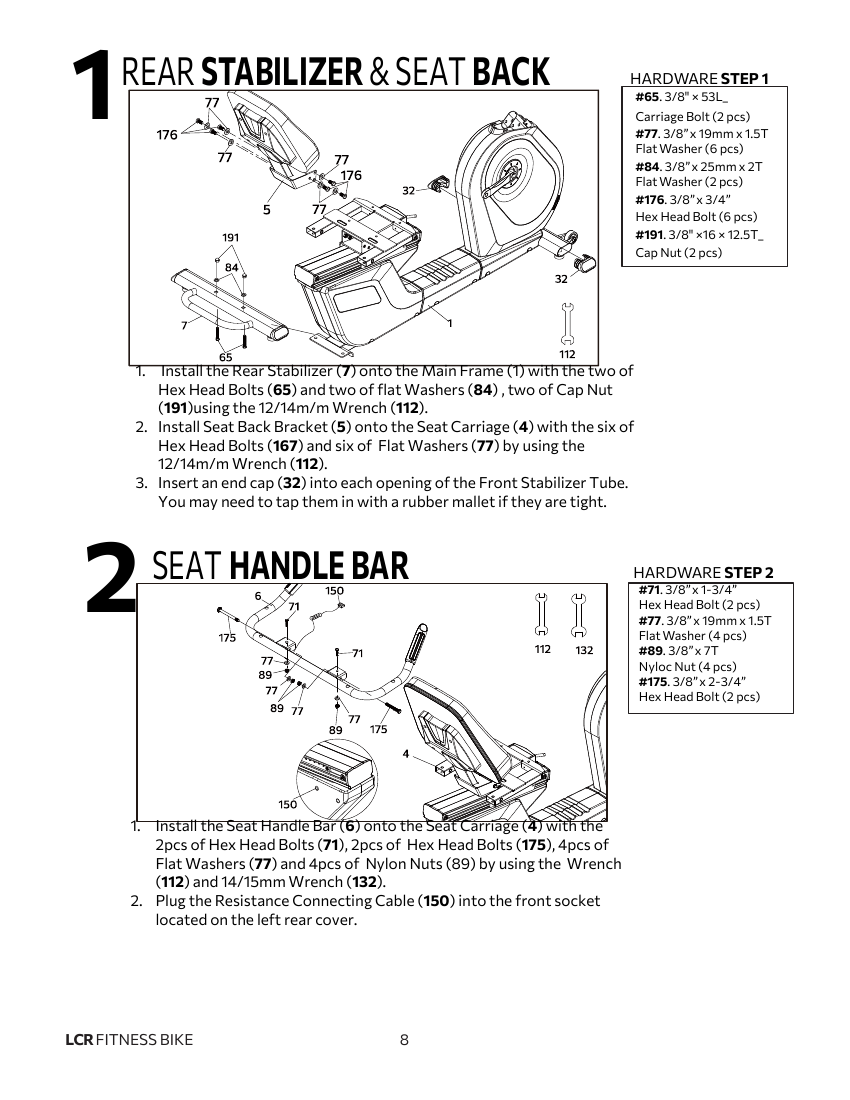
At retrieval, the product page showed only a title graphic saying studio photos were coming soon; its twenty-level figure is disputed, so the graphic remains source evidence, not product imagery. The linked LCR_2026 Ver.A owner's manual includes the model-specific assembly diagram shown here, clearly a drawing rather than a product photograph. It identifies the manual family but cannot verify a seller's frame, console, finish, package or serial/manual pairing. Request current photographs of the exact SKU and console if those details matter.
Bottom line
The LCR-2026 is a distinct large-screen recumbent configuration with a documented Zwift listing, 350 lb published limit, 56 by 29 inch body and 15-position seat. Its claimed resistance count is unsettled by contradictory text on its own page; the product-page/manual use language also needs clarification, and no product photograph appeared in the captured route. The official manual assembly illustration is a model-specific drawing, not evidence of a particular seller's assembly or contents. Those caveats matter more than treating the 2026 name as a blanket improvement over LCR-2023. Confirm the SKU, console, actual resistance scale, supported app/account route, delivered manual, operating environment, warranty and room/delivery needs before buying. No hands-on ride, noise, assembly or software test is claimed here.
Key specifications
Key details at a glance
| US retail SKU | LCR-2026 |
|---|---|
| Riding format | Recumbent |
| Resistance mechanism | Ems (manufacturer label; mechanism not further specified) |
| Maximum user weight | 350 lb |
| Console | 15.6-inch color touchscreen with tilting and swiveling mount; exact product page lists preloaded streaming apps and app support. |
| Display size | 15.6 in |
| Listed length | 56 in |
| Listed width | 29 in |
| Listed height | 61 in |
| Assembled weight | 161 lb |
| Named connected apps | SOLE+ / Zwift / Peloton |
| Built-in USB charging port | Yes |
| Seat | Recumbent seat with back support; page lists 15 adjustment positions. |
Use the exact model’s instructions for operating limits, supplied equipment and version differences.
Sources for this review
Sources for this assessment
- SOLE US all-products catalogue, current rendered snapshot
- SOLE LCR Exercise Bike (2026), exact US product page
- SOLE LCR-2026 product variant JSON
- SOLE Bikes service and manuals index
- SOLE LCR Owner’s Manual, LCR_2026 Ver.A
- SOLE LCR-2026 image placeholder, not product photography
- SOLE US all-products catalogue — 2026-11-01 refresh
- SOLE LCR-2026 exact product page — 2026-11-01 refresh
- SOLE LCR-2026 product variant record — 2026-11-01 refresh
- SOLE LCR-2026 product-page graphic placeholder — 2026-11-01 visual recheck

Put the details together
Use the finder to compare format, app support, resistance steps and the limits that matter in your room.