
Your needs, this model
Does it fit your priorities?
Does the LCR meet a strict recumbent, 350-pound and 40-level screen?
The current LCR page identifies a recumbent bike with a 350 lb published maximum and 40 EMS settings; it lists 56 x 29 x 60 inches and a 152 lb unit weight. Those values are catalog screens only. They do not determine whether the seat, access or use case is suitable for a particular rider.
Explore this need in the finder →Does the LCR have Zwift or another named finder app?
The LCR page and linked manual identify SOLE+ and Bluetooth-related functions, but do not name Zwift, JRNY or Explore the World as a supported LCR training route. The app rule therefore leaves this model out when one of those named apps is essential; verify any exact third-party app/device pairing with SOLE.
Explore this need in the finder →Can I assume the current LCR is suitable for a studio or clinic?
No such conclusion is justified from the marketing page alone. It describes light-commercial settings, but the linked LCR_2026 Ver.A owner's manual says the bike is for residential use only and warns that any other application voids its warranty. Get written confirmation for the exact SKU, package, installation and warranty before any non-residential purchase.
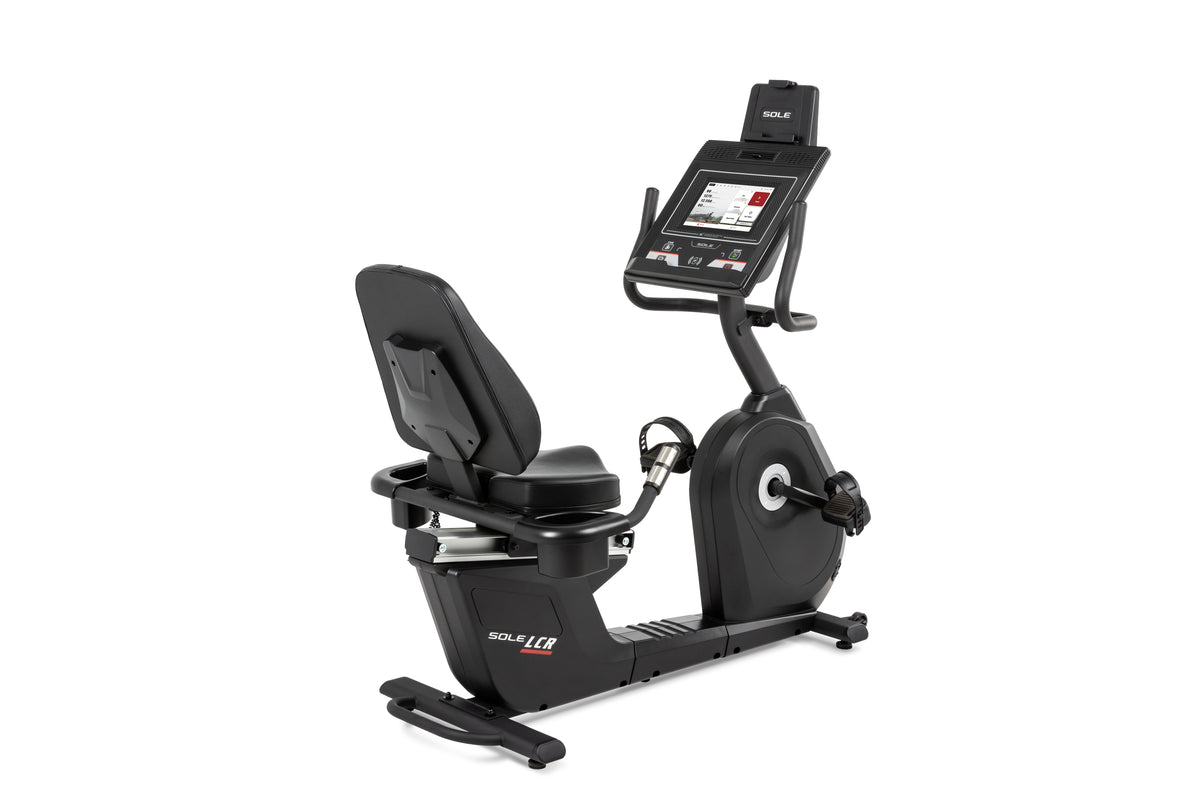
Explore this need in the finder →The current SOLE LCR listing has an easy-to-identify difference from the LCB: this is the recumbent member of the two light-commercial models, with a backrest and sliding seat instead of an upright saddle. Its product page gives the exact US SKU as LCR-2023 and lists 40 EMS resistance settings, a 350 lb maximum, a 10.1-inch touchscreen and a 56 x 29 x 60 inch body. The LCR_2026 Ver.A manual linked from SOLE's support index adds an important caveat that is not resolved by the marketing page: it states residential use only and warns that any other application voids the warranty. This review is a source-led desk assessment, not a personal ride or test.
Position and size are the first decisions
The recumbent layout changes how a shopper approaches the LCR. The current page describes a supportive back and a 15-position seat adjustment; it lists an inseam range of 43–54 inches. Those are useful screening points for comparing the LCR with upright bikes or with the shorter-rider setting on another recumbent, but they cannot predict comfort or safe access for a particular person. The page does not provide a personalized fit assessment, and a backrest does not by itself establish clinical or rehabilitation suitability.
The published body dimensions match the current LCB at 56 inches long, 29 inches wide and 60 inches high, but the LCR is listed at 152 lb versus the LCB's 112 lb. The difference matters at delivery: check stair, doorway and turn access and confirm whether the chosen delivery option includes moving the bike into the intended room. Body dimensions do not include space to approach the seat, swing a leg, reach the console or complete assembly.
Console features and resistance
SOLE lists 40 EMS resistance settings on the current LCR page. That is a setting count, not a standardized measure of peak resistance or smoothness, so do not compare the number directly with another maker's magnetic steps as if they measured identical effort. The same page specifies a 10.1-inch touchscreen, Wi-Fi, screen mirroring, speakers, cooling fans, tablet holder, wireless charging and Bluetooth-related functions. The linked LCR manual describes SOLE+ connectivity and the USB-C port's limited power output; it says the port is intended to power a device and does not store workout data. Check the exact console and cable in the delivered package before relying on that detail.
The product page names the free SOLE+ app and says it has no monthly subscription. The indexed manual describes syncing workouts through SOLE+ with services such as Apple Health, Google Health Connect, Strava and MapMyFitness. Those services are not the same claim as a bike's named support for Zwift, JRNY or Explore the World. The current LCR product information does not name those three finder apps for this SKU, so Bluetooth alone cannot satisfy one of those hard requirements. Ask about exact app, operating-system and device compatibility if an integration is essential.
Manual and warranty conflict: resolve it first
The live product page markets the LCR for clinics, studios, school weight rooms and multi-user homes. However, the current official bike manual index also links a separate document titled LCR_2026 Ver.A. Its first-page restriction says the fitness bike is intended for residential use only and says any other application voids the warranty. The same manual includes electrical instructions for a grounded 110 V outlet, model-family assembly steps and operating details. The current product page's light-commercial language and the manual's residential-use limitation are materially different, not two wordings that should be quietly combined.
A home buyer should still verify that the current manual matches the actual LCR-2023 listing and console package. A buyer considering any shared, clinic, studio, school or other non-residential setting should ask SOLE and the seller to confirm in writing whether the exact SKU and installation are covered, and should retain the matching manual and warranty. Do not rely on this assessment to choose a commercial machine based on the phrase “light commercial.” The older combined LCB/LCR 2023 Ver.E manual appears separately on the official index and should not be substituted for the linked LCR_2026 Ver.A document without checking the actual package.
How it differs from other recumbent options
Within this reviewed library, the LCR and SOLE's R92 and R98 share the recumbent frame category and 56 x 29 inch listed length and width. The R92 and R98 list 20 resistance steps and 300 lb maximum; the LCR lists 40 and 350 lb. The R98 names Zwift and Peloton, while the LCR page names SOLE+ but not those third-party apps. These differences affect a comparison, but they do not make the LCR a universal upgrade: its heavier listed unit mass, application restriction in the linked manual and current app uncertainty may matter more to a specific buyer than the higher setting count.
Checks before ordering
Confirm the LCR-2023 SKU, the exact 2026 manual revision, current warranty application and included console before paying. Measure the delivery route and intended room, then add separate space for access and assembly. Verify the grounded outlet and whether USB-C power or SOLE+ will work with the devices you plan to use. The product page includes a magnetic-field caution for wireless charging and advises people with implanted medical devices to consult their doctor; that notice should be taken seriously without turning it into personal medical advice.
Bottom line
The LCR is a substantial recumbent alternative when a backrest position, seat adjustment and a large screen are the desired format, and its current page provides unusually clear capacity and dimension checks. Its 350 lb and 40-level figures are not fitness or effort guarantees, and the linked LCR_2026 manual's residential-only language directly complicates the product page's light-commercial positioning. That limitation should be settled for the actual package before a non-home purchase. For a home shortlist, compare the LCR's larger mass and unresolved app claims with SOLE's R92/R98 and the Schwinn 230/290 based on the exact position, measurement and named app you need.
Key specifications
Key details at a glance
| US retail SKU | LCR-2023 |
|---|---|
| Riding format | Recumbent |
| Resistance mechanism | Ems (manufacturer label; mechanism not further specified) |
| Resistance levels | 40 |
| Maximum user weight | 350 lb |
| Console | 10.1-inch Android touchscreen with screen-mirroring features listed on the current product page |
| Display size | 10.1 in |
| Listed length | 56 in |
| Listed width | 29 in |
| Listed height | 60 in |
| Assembled weight | 152 lb |
| Named connected apps | SOLE+ |
| Bluetooth app protocol | Current product specifications list ble 3.0 audio, ble 5.0 and sole+ apps / ftms + cscs support. the linked lcr manual describes sole+ use; these facts do not establish universal third-party app support. |
| Built-in USB charging port | Yes |
| Seat | Adjustable padded backrest and recumbent seat |
Use the exact model’s instructions for operating limits, supplied equipment and version differences.
Sources for this review
Sources for this assessment
Put the details together
Use the finder to compare format, app support, resistance steps and the limits that matter in your room.