Your needs, this model
Does it fit your priorities?
What riding format does SOLE assign to SB700?
SOLE’s official comparison treats SB700 as an indoor-cycle/studio-style family and differentiates its felt-pad friction brake from the magnetic SB900. The exact retail SKU is unresolved, so this label is a model-family observation rather than a unit identification.
Explore this need in the finder →Does SB700 have a confirmed numbered resistance-level count?
No count is published in the reviewed SB700 comparison. It describes a friction brake adjusted with a turn dial; a manually turned dial does not establish a numbered level scale. Exact operating instructions for a particular SB700 unit remain unavailable.
Explore this need in the finder →Which listed body figures does the SB700 family comparison provide?
SOLE’s comparison lists a 40 x 21 x 42 inch body, 141 lb item mass and a 300 lb maximum. These are attributed family figures, not independent measurements or an individual fit decision, and no exact retail/serial bridge was found. Add room for movement, access, assembly and delivery beyond the body outline.
Explore this need in the finder →Does this record confirm Zwift or another finder-named app?
No named finder-app connection is confirmed for an exact SB700 configuration. The comparison table says no Bluetooth, while broader article wording groups both models with SOLE+; without an exact console manual/product page, do not infer Zwift, JRNY or Explore the World support. This family reference is excluded from buying matches.
Explore this need in the finder →A separate indoor-cycle family, not a resolved retail unit
SOLE's model comparison names the SB700 separately from the SB900 and describes it as an indoor cycle with a felt-pad friction brake. That makes it relevant to a buyer trying to distinguish two older studio-style frame families. It does not establish the exact US SKU, serial revision, present offer or included package. The direct SB700 route currently leads to the general Bikes collection, and the store's product-data endpoint returned 404; the current Bikes and manual-index snapshots show no SB700 product card or matching manual entry. I therefore treat this as a reference to the manufacturer-described SB700 family, not as an available product or a purchase recommendation.
What the comparison attributes to SB700
The SOLE comparison gives the SB700 a 48 lb flywheel, a turn-dial friction system using a felt pad, a compact 3 by 4 inch LCD and toe-cage pedals. Its comparison table reports a 300 lb capacity and a 40 by 21 by 42 inch body, with a listed item mass of 141 lb. A separately inspected SOLE/Dyaco global page is explicitly titled “Bike SB700 2019”; it also reports a 48 lb flywheel and felt-pad brake, but lists a 47.6 by 21.1 by 47.8 inch body and 138.8 lb net / 149.9 lb gross mass. No U.S. SKU, serial or manual ties that page to a U.S. unit. The distinct source values therefore remain an unresolved configuration/measurement conflict, not a reason to choose whichever number seems convenient. A friction dial does not imply numbered levels, so this record does not invent a resistance count or let the SB700 meet a numeric level requirement.
The same article lists dual bottle holders and summarizes a lifetime frame warranty with different parts and labor terms from the SB900. It also describes light-commercial warranty coverage. Those are time-sensitive statements from a comparison page, not a current warranty certificate, and they do not tell a secondhand buyer whether coverage transfers or whether a particular installation is eligible. Ask SOLE for the exact unit's current manual, warranty and service status before relying on any use claim.
Friction changes the maintenance question
Compared with the magnetic SB900, SOLE describes the SB700 as using a physical felt pad pressed against the flywheel. The manufacturer says that arrangement creates more operating sound and calls for pad replacement over time. It describes the feel as closer to a road-style friction control, but no independent sound reading, pedal-force measurement or riding comparison was performed for this assessment. The SB700's 48 lb flywheel is heavier than the 35 lb figure reported for SB900, but flywheel mass alone cannot establish that one bike feels smoother or better: brake design, drive and the unit's condition matter too.
The comparison also labels the SB700 as having no Bluetooth connectivity, while its broad introduction says both bikes include SOLE+ access. Without an exact SB700 page or console manual, that inconsistency does not establish what a particular unit can connect to. Do not treat a broad app statement, generic brand app, or screen alone as a confirmed Zwift, JRNY or Explore the World route. Request the console model and its actual connection options, and verify whether any required account or device is still supported.
Room and delivery checks still require the exact machine
SOLE's U.S. comparison lists a 40 by 21 by 42 inch SB700 body, while its global 2019 page lists 47.6 by 21.1 by 47.8 inches. Without a SKU, serial or manual bridge for the U.S. comparison family, neither dimension set can be assigned confidently to a particular U.S. unit, so this reference stores its body dimensions as unknown rather than matching a buyer to a room limit. Both sets exclude room for the rider, moving pedals, safe entry and exit, service access and assembly; measure the actual unit and access path. The comparison's 141 lb item-mass claim and the global page's separate net/gross figures also should not be treated as interchangeable. Confirm the actual bike, carton, transport route and delivery responsibility with the seller rather than designing a move from family-level figures.
A 300 lb maximum is a stated equipment limit, not a personal comfort, safety or medical recommendation. The sources do not supply a serial-specific fit chart, rider-height interval, adjustment range or exact pedal interface beyond the family-level toe-cage description. Confirm the saddle and handlebar adjustment, pedals, frame label and control feel on the actual unit if those determine whether it can work for you.
How to identify a used SB700
Ask for clear images of the model/serial label, brake and pad, console, crank, pedal faces and included accessories. Request the manual that shipped with the same serial, and ask SOLE whether it can identify the revision and whether replacement felt pads and other parts are still available. Inspect wear, friction adjustment, flywheel contact surface and control action before taking an older unit; a manufacturer's comparison article is not a condition report. Verify warranty transfer, return terms, repair history, power needs and delivery details with the seller.
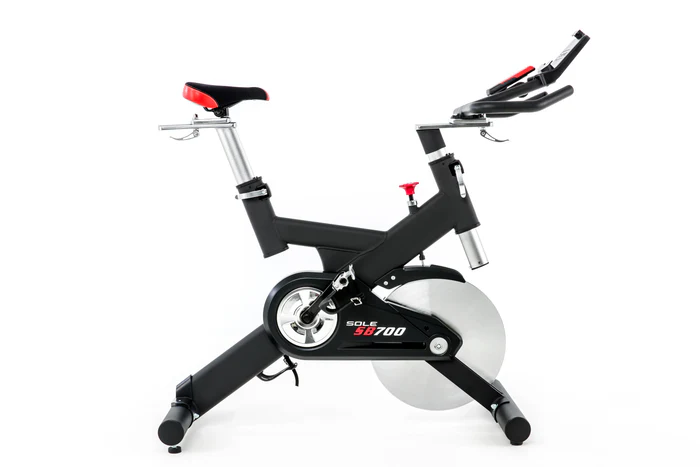
SOLE's comparison places a separate image beside its SB700 section; the bike's flywheel cover visibly carries the SB700 name. That is a useful manufacturer-published visual for the model family, but it does not identify a retail SKU, serial revision or exact console and parts package, so it should not be read as a photograph of every SB700 unit. The current manual index still has no SB700 entry, and the product route and store data do not establish a live SKU or offer.
Bottom line
The official SOLE sources establish a useful SB700 family outline: friction/felt-pad resistance, a 48 lb flywheel, toe cages, a single LCD and a 300 lb published limit. The U.S. comparison and the separate global 2019 product page disagree on body dimensions, and the exact U.S. package, SKU, manual and serial remain unknown, so the site does not use either geometry as a fit fact. The comparison's claims about maintenance and light-commercial warranty coverage also need checking against the exact unit, not treatment as a current guarantee. Keep this reference distinct from the magnetic SB900 and touchscreen SB1200. This is source-led work only—no ride, sound, power, console, durability, assembly or customer-experience testing is claimed.
Key specifications
Key details at a glance
| Riding format | Indoor cycling / studio-style bike |
|---|---|
| Resistance mechanism | Friction/felt-pad brake actuated by a turn dial, as described by sole |
| Maximum user weight | 300 lb |
| Console | The SOLE comparison table lists a 3 x 4 inch LCD and no programs; exact console version and package are unknown. |
| Named connected apps | |
| Pedals | Sole’s comparison describes toe-cage pedals at family level; verify pedal faces and straps on the exact unit. |
Use the exact model’s instructions for operating limits, supplied equipment and version differences.
Sources for this review
Sources for this assessment
- SOLE US Bikes collection, current rendered snapshot
- SOLE Bikes Service and Manuals index
- SOLE: SB900 versus SB700 Exercise Bike Comparison
- SOLE SB700 family image in official comparison article
- SOLE US Bikes collection — 2026-11-01 refresh
- SOLE US all-products catalogue — 2026-11-01 refresh
- SOLE Bikes service and manuals — 2026-11-01 refresh
- SOLE SB700 product route — 2026-11-01 redirect check
- SOLE SB900 versus SB700 manufacturer comparison — 2026-11-01 refresh
- SOLE/Dyaco global fitness-bike catalogue — 2026-11-02 snapshot
- SOLE/Dyaco global Bike SB700 2019 product page
Put the details together
Use the finder to compare format, app support, resistance steps and the limits that matter in your room.