Your needs, this model
Does it fit your priorities?
Does the 2019 SB700 have a documented numeric resistance-level count?
No. The global page describes multilevel felt-pad resistance controlled by a turn dial, and the U.S. comparison likewise does not give a numbered scale. A dial is not a level count.
Explore this need in the finder →Which SB700 body dimensions should a U.S. owner use?
Neither published set can be assigned to an exact U.S. unit: the global 2019 page lists 47.6 x 21.1 x 47.8 inches, while the U.S. family comparison lists 40 x 21 x 42 inches. Measure the actual frame and allow separate entry, pedal and service clearance.
Explore this need in the finder →Does the 2019 SB700 have confirmed Bluetooth app support or SPD pedals?
No named app is established: the global page lists SOLE App N/A and the U.S. comparison table says no Bluetooth. Pedal descriptions also differ between the global page's oversized pedals and the U.S. comparison's toe cages, so check the actual unit rather than promising an app or clipless interface.
Explore this need in the finder →The SOLE SB700 Bike 2019 is an older, reference-only model-year record. The global manufacturer page describes a felt-pad, dial-controlled cycle; U.S. service-parts catalogues associate an SB700 2018–2020 family with code 570119 and an independent index identifies that code as 2019. This establishes a useful model-year trail, but not a specific bike's physical serial, whole-bike retail SKU, current offer or supplied package. It is also important not to pretend that the published U.S. and global dimensions agree: they do not.
How its resistance is described
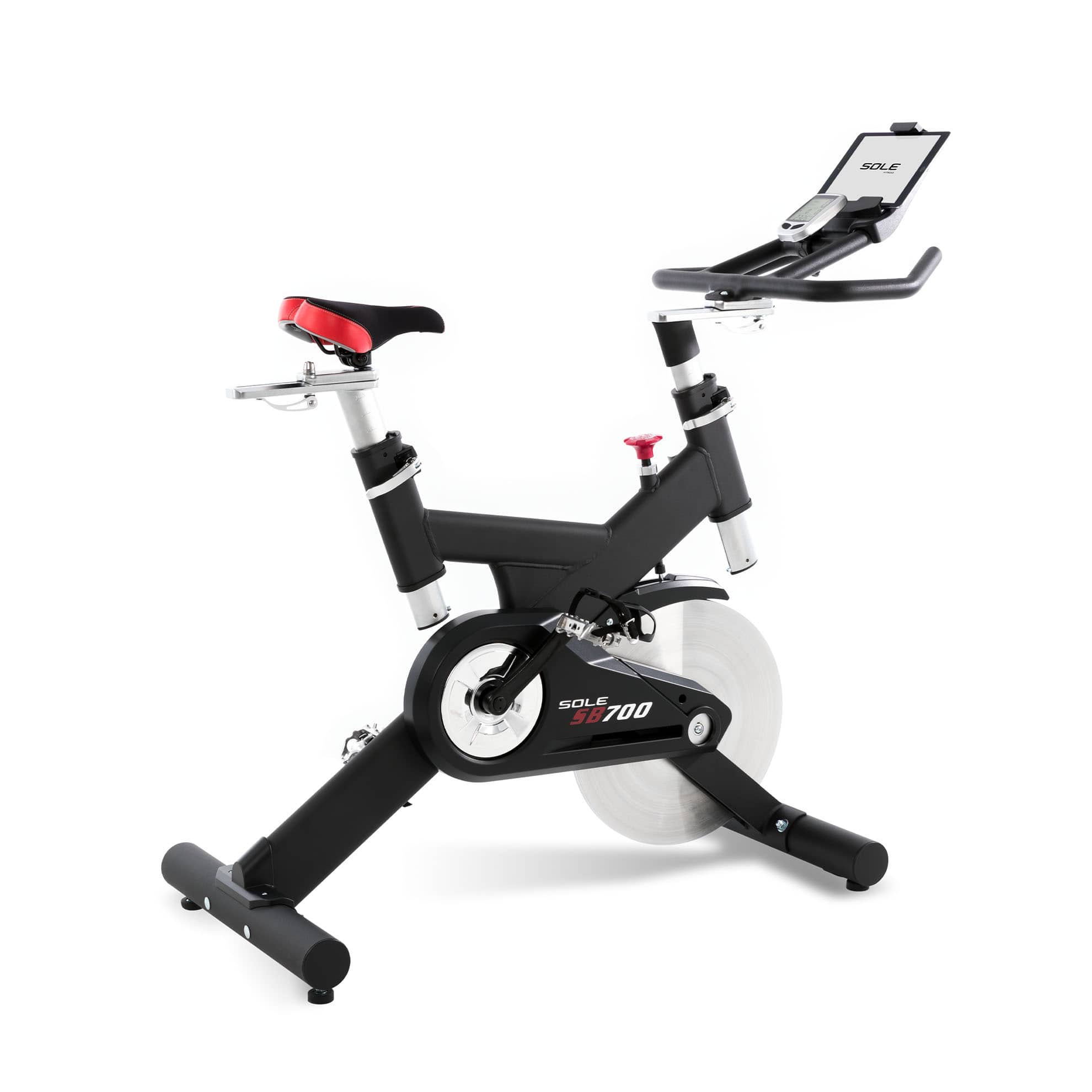
The global 2019 page calls the system a felt-pad push brake with multilevel resistance and a turn dial. Its table lists a 48 lb flywheel, single LCD and a 300 lb maximum user weight. The page gives no numbered level count, so a visitor who needs a stated number of settings should treat that value as unknown rather than infer one from “multilevel.” The U.S. manufacturer comparison also describes the SB700 as a felt-pad, dial-operated family and lists the same 48 lb flywheel and 300 lb limit. That corroborates the broad format, not every detail of a particular 2019 U.S. bike. The global 2019 product page
Simple console, but check the actual controls
The global page lists a single LCD window and a field for personal information, while the U.S. comparison describes a compact screen displaying basic workout figures. Neither source establishes a modern touchscreen, named app pairing or a numbered resistance display. The global table marks SOLE App as not applicable. The U.S. comparison contains broader SOLE+ copy around both bikes, but its SB700-specific table says no Bluetooth; that conflict is not a reason to claim app support. Treat the 2019 configuration as having no confirmed named app integration, and inspect the console on the actual unit before assuming that any display, tablet mount or sensor works.
Adjustment, pedals and an unresolved footprint
The global 2019 page says that seat and handlebars adjust and calls the pedals oversized. It does not give adjustment travel or rider-height limits. The U.S. family comparison describes toe cages and dual bottle holders, but no exact 2019 serial or package crosswalk establishes which pedal set or accessories a given seller has. Check the bike rather than choosing a pedal system from the model name. More importantly, the global page lists 47.6 x 21.1 x 47.8 in, while SOLE's U.S. comparison lists 40 x 21 x 42 in for the SB700 family and also gives a different mass figure. Neither dimension set is safe as an exact U.S.-unit footprint. Measure the bike in front of you and plan separately for entry, pedal movement, delivery and service access.
Why this is not the SB900
The SB700 is a friction-brake model in the manufacturer comparison; that source distinguishes it from the magnetic SB900. A felt pad requires a different maintenance question from a magnetic carriage: ask when it was last inspected or replaced and whether the seller can identify the correct part from the unit label. The parts listings show that model-specific brake components exist, but they are service-catalogue entries rather than evidence about the condition of a used bike. The U.S comparison page's original article body is dated May 9, 2025 and calls the SB700 a last-generation model sold out online; that dated language is not a current stock report or price. The separate U.S family assessment is at SOLE SB700 indoor-cycle family reference.
Reading the model-year code carefully
The U.S.-labelled Tread.parts catalog groups 2018–2020 parts under code 570119 and includes parts explicitly tagged for 2019; an independent service index likewise lists SB700 570119 as the 2019 model-year family. These are model/parts references, not a manufacturer retail SKU or proof that a particular physical bike carries the right manual. The U.S. model-family comparison does not identify an exact year or serial, and its dimensions conflict with the global 2019 page. Keep both records separate and ask SOLE service to match the bike's actual frame label before ordering parts or relying on a specification.
Practical checks before a used-bike decision
Ask for a clear serial/model-label photo and the manual that belongs to that code. Inspect the felt pad, resistance rod, flywheel area, adjustment locks, console and pedal threads; confirm the brake engages and releases as the manual specifies. Those are sensible questions for a secondhand inspection, not claims of hands-on testing. Verify the exact body dimensions with a tape measure, confirm the saddle and bars reach the intended position, and identify which pedals, console, holders and tools are included. Check the seller's return and service terms independently: no current whole-bike U.S. offer, exact retail SKU, transferable warranty, new-unit price or package has been verified here.
Bottom line
The 2019 model reference helps identify the SB700's manual friction format and distinguishes it from magnetic systems, but it is not enough to promise a precise match for a particular U.S. used unit. Its broad resistance style and flywheel/capacity claims are documented; exact footprint, assembly, console, pedals, warranty, condition and current availability are not. Use the model and serial-family evidence to ask better questions, then let the actual bike and its own manual resolve the remaining details.
Key specifications
Key details at a glance
| Riding format | Indoor cycling / studio-style bike |
|---|---|
| Resistance mechanism | Felt-pad push brake, as reported on the global 2019 sb700 page |
| Maximum user weight | 300 lb |
| Console | The global page describes a single LCD window and says personal information can be inserted and displayed. The U.S. family comparison describes a 3 x 4 inch LCD with basic workout metrics. Exact year/serial console version is not established. |
| Named connected apps | |
| Pedals | The global page says oversized pedals; the u.s. comparison describes toe cages. exact pedal fit and installed package for an individual u.s. unit are unknown. |
Use the exact model’s instructions for operating limits, supplied equipment and version differences.
Sources for this review
Sources for this assessment
- SOLE/Dyaco global exercise-bike catalogue: Bike 2019 and Bike 2023 groups
- SOLE/Dyaco Bike SB700 2019 product page
- Tread.parts: Sole SB700 2018–2020 parts category, code 570119
- Hydra Fitness Exchange stationary-bike model/serial-family index
- SOLE U.S. SB900 and SB700 family comparison
- SOLE U.S. Bikes — Service and Manuals index
Put the details together
Use the finder to compare format, app support, resistance steps and the limits that matter in your room.